You are mid-recipe. The butter is creamed. The eggs are ready. You reach for the brown sugar — and it is a solid brick.
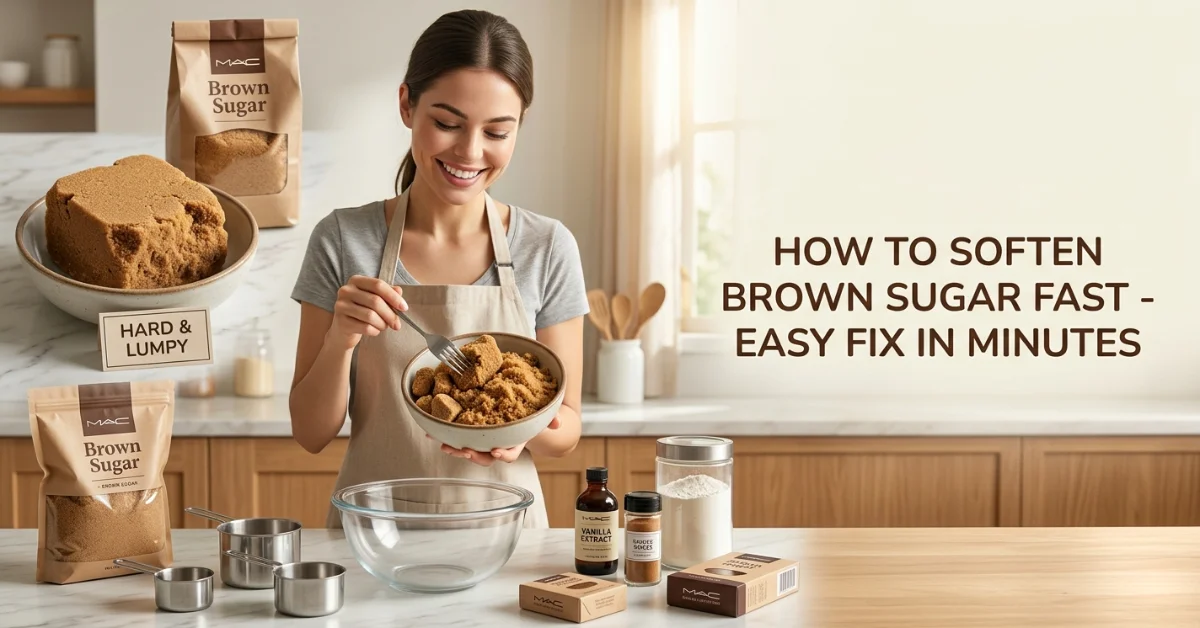
This happens to every baker. Brown sugar hardens when its moisture evaporates, turning soft granules into something resembling concrete. The good news: you can soften brown sugar fast — in as little as 20 seconds — with things already in your kitchen.
This guide covers six proven methods, ranked by speed. Sourced from Preppy Kitchen (John Kanell), C&H Sugar, Amateur Gourmet (Adam Roberts), Serious Eats, and Reddit r/AskCulinary. Every warning, every tip, every detail included.
Why Does Brown Sugar Get Hard in the First Place?
Understanding the cause saves you from the problem in the future.
Brown sugar is simply white granulated sugar coated in molasses. That molasses contains natural moisture — and moisture is everything. When air reaches the sugar, that moisture slowly evaporates. As it does, the sugar crystals bond together, forming the rock-hard mass you are now dealing with.
It happens faster when stored in an open box, a half-sealed bag, or a container with a loose lid. But even a well-sealed container will lose moisture gradually over time. Both light brown sugar and dark brown sugar harden in the same way — dark brown just has more molasses, so it takes slightly longer.
For more info: How to Make Homemade Butter with Just One Ingredient
Can I Still Use Brown Sugar That Has Hardened?
Yes — absolutely. Hardened brown sugar is not spoiled. It has the same flavor and chemistry as soft sugar. The problem is purely textural. Hard sugar will not dissolve evenly in wet ingredients, will not cream smoothly with butter, and can leave hard lumps in cookies, cakes, muffins, and cinnamon rolls.
Always soften hard brown sugar before baking. Using it brick-solid will affect your final baked goods — uneven texture, dense crumb, and gritty spots in your dough or batter.
Per Serious Eats: Hard brown sugar that smells normal and has no mold is perfectly safe to use — you just need to restore its moisture content before incorporating it into any recipe.
How to Soften Brown Sugar Fast – 3 Quick Methods
Need it now? These three methods soften hard brown sugar in under 30 minutes — no overnight waiting required.
Microwave Method — Fastest Fix: 20 to 40 Seconds
This is the fastest way to soften brown sugar and the go-to method recommended by Preppy Kitchen’s John Kanell and C&H Sugar. It takes under a minute.
- Place the hardened sugar in a microwave-safe bowl
- Wet a paper towel and wring it out thoroughly — it should be damp, not dripping
- Lay the damp paper towel over the sugar. For a deeper fix, cover the bowl tightly with plastic wrap over the paper towel (C&H method)
- Microwave in 20-second increments — check and break up with a fork after each round
- Use immediately — the sugar will be hot and will harden again as it cools
Critical Warning: Do NOT soak the paper towel. A dripping-wet towel adds too much water — this starts to melt the sugar crystals, turning your brown sugar into a pasty, sticky mess that clumps worse than before. Wring it until barely damp.
Use Immediately: Microwave-softened brown sugar hardens again as it cools. Only microwave the amount you actually need for your recipe. Softening then letting it sit for 10 minutes defeats the purpose.
Oven Method — No Microwave Needed: 5 to 10 Minutes
This is the method Amateur Gourmet’s Adam Roberts discovered and documented when he had no microwave. It works reliably when done at the right temperature.
- Preheat oven to 250°F — this is the key temperature confirmed by C&H Sugar
- Spread the hardened sugar onto an oven-safe pan
- Add a splash of hot water to the pan, or lay a damp paper towel across the sugar
- Place in oven and watch carefully — sugar softens quickly
- Remove as soon as it softens. Break up with a fork. Use immediately
Why 250°F and NOT 350°F: Amateur Gourmet originally used 350°F — but this risks caramelizing or partially melting the sugar. At 250°F, the gentle heat simply restores moisture without altering the sugar’s chemistry. Always choose the lower temperature.
Zip-Top Bag Water Method — No Equipment: 15 to 30 Minutes
No microwave, no oven, no equipment at all. This method from C&H Sugar’s baking guide works with just a bag and a measuring spoon.
- Place 8 oz of hardened brown sugar into a zip-top bag
- Add exactly ¾ teaspoon of water — not more
- Seal the bag. Knead and squeeze until the water distributes and the clumps dissolve
- Continue kneading for 15–30 minutes until fully soft
Why the measurement matters: Too much water and you risk dissolving the sugar crystals entirely — creating a syrup rather than granulated sugar. Three-quarters of a teaspoon is precisely calibrated to restore moisture without melting structure
How to Soften Brown Sugar Overnight – 3 Slow Methods
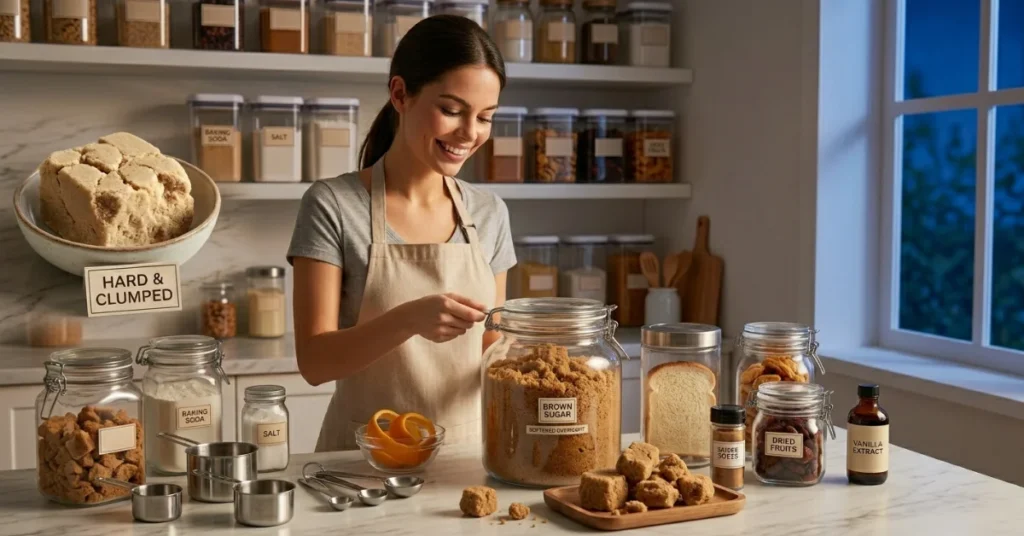
Have time to plan? These overnight brown sugar softening methods work while you sleep — and are better for large batches.
Bread Slice Method — 8 to 24 Hours
The most classic overnight fix. Fresh bread releases moisture slowly, transferring it gently into the hardened sugar.
- Place the hard brown sugar in a tightly sealed container
- Lay one or two slices of fresh bread directly on top of the sugar
- Seal the container. Leave overnight or up to 24 hours
- Check sugar softness. Remove the bread as soon as the sugar is soft
Remove the bread immediately: Leaving bread in the container too long causes mold growth. Once the sugar is soft, the bread comes out.
Apple Slice Method — 4 Hours to Overnight
Apple slices work on the same principle as bread — they release moisture. But this method has an important caveat that Preppy Kitchen and Serious Eats both flag.
- Place apple slices directly on top of the sugar in a bowl
- Wrap tightly with plastic wrap
- Leave for 4 hours to overnight
- Remove apple slices immediately and use the sugar right away
Important Flavor Note: Apple slices can impart a subtle apple flavor to your brown sugar. This is actually desirable for certain recipes — apple muffins, banana bread, spiced cakes. But for chocolate chip cookies or caramel sauce, where apple flavor would be intrusive, choose a different method
Terra Cotta Disk / Sugar Bear Method — Overnight
The terra cotta sugar saver disk — also called a sugar bear or brown sugar keeper — is the most durable softening and storage solution available. Recommended by both C&H Sugar and Preppy Kitchen’s John Kanell.
- Soak the unglazed terra cotta disk in water for 10–15 minutes
- Pat dry with a towel — remove surface water but keep the clay saturated
- Place the disk in a tightly sealed container with the hardened sugar
- Leave overnight. The clay slowly releases moisture into the sugar, softening it evenly
- Keep the disk in the container permanently for ongoing softness — re-soak every few months
Speed and Effort Comparison – Which Method Is Best for You?
Not sure which method to use? Here is the complete comparison — pulled from testing by C&H Sugar, Preppy Kitchen, and the Reddit r/AskCulinary community.
| Method | Time | Equipment | Best For | Key Warning |
| Microwave | 20–40 sec | Microwave + bowl | Any recipe, right now | Use immediately — hardens as it cools |
| Oven | 5–10 min | Oven + pan | No microwave situations | Use 250°F — not higher |
| Zip-top bag | 15–30 min | Bag only | Mid-recipe, no appliances | Exactly 3/4 tsp water only |
| Bread slice | 8–24 hours | Container | Large batches, next-day baking | Remove bread immediately after softening |
| Apple slices | 4–24 hours | Bowl + wrap | Apple or spiced recipes only | Re-soak the disk every few months |
| Terra cotta disk | Overnight | Disk + container | Long-term storage solution | Re-soak disk every few months |
For most bakers, the microwave method wins every time for speed. The zip-top bag water method wins when no microwave is available, and you need it in under 30 minutes. The bread method wins for large batches planned the night before.
Per Reddit r/AskCulinary, the most consistently recommended method across home baker communities is the damp paper towel + microwave combination — fast, reliable, and requires nothing you do not already have on hand.
How to Keep Brown Sugar Soft – Long-Term Storage Tips
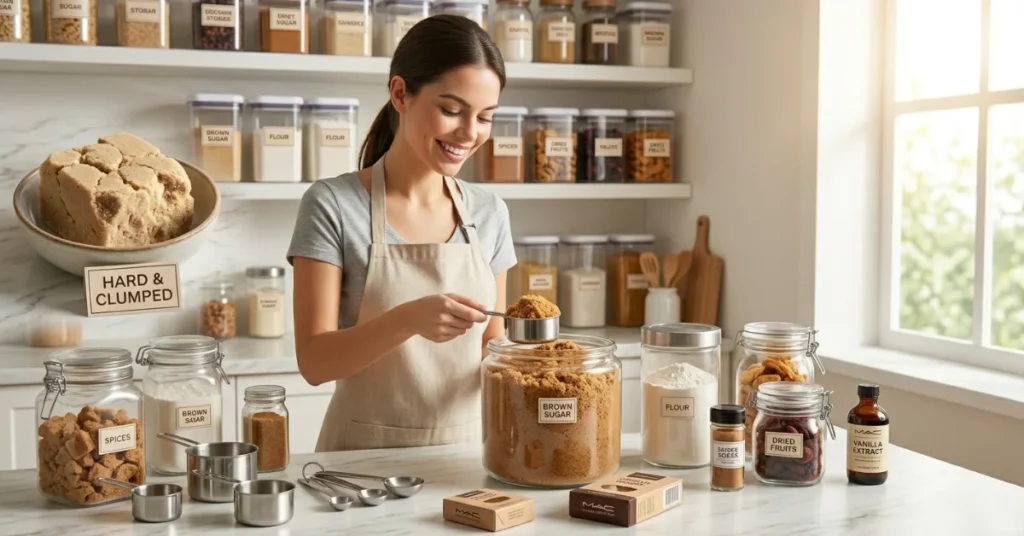
The best fix for hard brown sugar is preventing it from hardening in the first place. These are the storage habits that actually work.
The Marshmallow Trick — John Kanell’s Go-To Method
This is Preppy Kitchen’s John Kanell — a two-time New York Times bestselling cookbook author — and this is his favorite long-term storage method. It is simpler than anything else on this list.
Add 4–5 large marshmallows to your brown sugar container. Seal tightly. The marshmallows slowly release moisture into the sugar over time, keeping it perpetually soft.
The genius of this method: marshmallows have a stable shelf life — they will not cause the sugar to spoil or go moldy the way bread or apple slices might. Replace the marshmallows when they start to feel hard — that means they have done their job.
Airtight Container — The Non-Negotiable Foundation
Every other storage trick is secondary to this one. Brown sugar must be stored in a tightly sealed, airtight container — always. The moment air reaches the sugar, moisture begins to evaporate.
- Tupperware — recommended by long-term Preppy Kitchen community members for its exceptional seal
- Any airtight glass or plastic container with a snap or screw-top lid
- Never store in the original open box or a half-sealed zip bag — these lose moisture within days
Terra Cotta Disk for Ongoing Storage
Keep the terra cotta sugar saver in your brown sugar container permanently. After the initial softening use, it becomes a continuous moisture regulator. Re-soak the disk in water every 2–3 months to refresh its moisture output.
Make Your Own Brown Sugar — The Backup Plan
If your brown sugar is simply too hardened to rescue — or you have run out entirely — make fresh brown sugar in two minutes. Mix 1 cup of granulated white sugar with 1 tablespoon of molasses (for light brown) or 2 tablespoons (for dark brown). Stir until fully combined. Use immediately or store as above.
Frequently Asked Questions
How to get brown sugar to soften quickly?
The fastest way to soften brown sugar quickly is the microwave method: place sugar in a microwave-safe bowl, cover with a damp (not dripping) paper towel, and microwave in 20-second increments. Break up clumps with a fork after each round. Total time: under 1 minute. Use immediately — the sugar will re-harden as it cools. For a non-microwave option, the zip-top bag + ¾ tsp water method works in 15–30 minutes with no equipment.
Can I still use brown sugar that has hardened?
Yes — hardened brown sugar is completely safe to use. It has not spoiled or lost any flavor. The issue is purely textural — hard sugar will not dissolve evenly or cream properly with butter. Always soften it before baking to avoid lumps, uneven texture, and dense spots in your finished baked goods. If the sugar smells normal and shows no mold, it is perfectly usable once softened.
What do you add to brown sugar to make it soft again?
The most effective additions to make hard brown sugar soft again are: a damp paper towel (microwave method), a splash of hot water (oven method), ¾ tsp of water (zip-top bag method), a slice of fresh bread (overnight method), apple slices (4-hour method), or a soaked terra cotta disk (overnight method). All methods work by reintroducing moisture into the dried-out sugar crystals. The key principle: a small, controlled amount of moisture — never saturate the sugar.
How do you make hard brown sugar soft again without a microwave?
Three excellent options for softening hard brown sugar without a microwave: (1) Oven at 250°F — spread sugar on an oven-safe pan with a splash of hot water, watch carefully, remove as soon as soft. (2) Zip-top bag — add exactly ¾ tsp water to 8 oz sugar in a sealed bag, knead until soft (15–30 minutes). (3) Bread slices in an airtight container overnight — bread releases moisture slowly, softening even large blocks within 8–24 hours. Remove bread immediately after softening.
Can I add water to brown sugar to soften it?
Yes — but only in a very precise, small amount. Per C&H Sugar’s official baking guide, the correct ratio is ¾ teaspoon of water per 8 ounces of brown sugar. Too much water begins to dissolve the sugar crystal structure, turning granulated sugar into a syrupy paste or causing it to clump worse once dry. Always measure the water before adding it. The zip-top bag kneading method is the safest way to add water, as it distributes the moisture evenly throughout the sugar.
How do you keep brown sugar soft naturally?
The most effective natural ways to keep brown sugar soft: (1) Marshmallows — add 4–5 large marshmallows to your airtight container; they slowly release moisture without causing spoilage (John Kanell’s method). (2) Terra cotta sugar saver — a pre-soaked clay disk kept permanently in the container, re-soaked every 2–3 months. (3) Airtight storage always — never leave sugar in its original box or unsealed bag. The marshmallow method is the simplest and most maintenance-free option for most home bakers.
Conclusion:
Hard brown sugar is not a disaster — it is a two-minute fix with the right method.
For speed: microwave with a damp paper towel. For no-microwave situations: 250°F oven or the zip-top bag method. For overnight: bread slice or terra cotta disk. And to stop it happening again: an airtight container plus marshmallows.
Soft sugar. Better baking. Every time.