You just finished eating. Your meal is gone. But where did it go — and how fast?
Most people assume digestion is quick. It isn’t. Understanding how fast you digest food can completely change how you eat, how you feel, and how healthy your gut really is.

What Actually Happens When You Digest Food
Digestion isn’t just what your stomach does. It’s a coordinated, multi-organ process that begins before you even take your first bite.
Your brain fires first. The moment you see or smell food, your salivary glands activate. This is called the cephalic phase of digestion — your body preparing the digestive system before food arrives.
The Mouth — Where Digestion Truly Begins
When food enters your mouth, chewing breaks it into smaller pieces. Your saliva contains amylase — a digestive enzyme that starts breaking down starch immediately. The result is a soft, chewed mass called a bolus.
Chewing longer matters more than most people think. The smaller the bolus, the easier the rest of the digestive tract can process it.
The Esophagus — The Food Highway
Once swallowed, the bolus travels down the esophagus in just 2–8 seconds through rhythmic muscle contractions called peristalsis — wave-like squeezing motions that push food downward.
At the bottom sits the lower esophageal sphincter (LES) — a ring-shaped muscle that opens to let food into the stomach, then closes immediately to prevent acid reflux. The epiglottis — a small protective flap — folds over the windpipe during swallowing so food doesn’t enter the lungs.
The Stomach — The Real Mixing Chamber
Your stomach is an active processing organ with powerful gastric acid (hydrochloric acid) and digestive enzymes that convert food into a semi-liquid substance called chyme.
According to Cleveland Clinic gastroenterologist Dr. Christine Lee, MD, food generally stays in your stomach between 40 minutes and 2+ hours. The denser the food, the longer it stays.
The Small Intestine — The Nutrient Powerhouse
The small intestine — roughly 20 feet long — is divided into three sections:
- Duodenum — receives chyme, mixes it with bile from the gallbladder and enzymes from the pancreas
- Jejunum — absorbs most nutrients including proteins, carbohydrates, and fats
- Ileum — absorbs vitamin B12, bile acids, and remaining nutrients before passing waste to the colon
Nearly 90% of all nutrient absorption happens here. The liver produces bile to break down fats. The pancreas contributes digestive enzymes and produces insulin to regulate blood sugar.
The Large Intestine — The Final Processor
Once nutrients are extracted, waste enters the large intestine (colon). The colon absorbs remaining water and electrolytes, converting leftover material into stool. Your gut microbiome — trillions of bacteria in the colon — ferments undigested fiber, producing short-chain fatty acids that feed your colon cells.
This stage takes the longest — anywhere from 10 to 59 hours.
The Gut-Brain Axis
Your gut and brain communicate constantly through the vagus nerve — a direct neural highway connecting your digestive system to your brain. This is called the gut-brain axis.
Stress, anxiety, and emotions directly affect your gastrointestinal motility — how fast or slow food moves through your system. This is why nervous people experience diarrhea before big events, and why chronic stress causes chronic digestive problems.
💡 The gut contains over 100 million nerve cells — more than the spinal cord. It’s often called the “second brain” for good reason.
For more info: Muscle Growth Timeline: What to Really Expect in 30, 60, and 90 Days
How Long Does It Really Take to Digest Food?
The short answer: 24 to 72 hours for complete digestion. That surprises most people. Here’s the full breakdown by stage.
Stage-by-Stage Digestion Timeline
| Stage | Organ | Time |
| Chewing & swallowing | Mouth | 5–30 seconds |
| Food transport | Esophagus | 2–8 seconds |
| Breakdown & mixing | Stomach | 40 min – 5 hours |
| Nutrient absorption | Small intestine | 2–6 hours |
| Water absorption & stool | Large intestine/Colon | 10–59 hours |
| Total transit time | Mouth to elimination | 24–72 hours |
This data is consistent across NIDDK, Donat nutritionist Kristina Aralica Tušak, and IMODIUM’s digestive health research.
What Colorado State University Research Actually Shows
Colorado State University’s VIVO Pathophysiology research — using scintigraphic analysis (tracking radioactively labeled meals through the body) — provides precise GI transit data:
- 50% of stomach contents emptied: 2.5–3 hours
- Total stomach emptying: 4–5 hours
- 50% of small intestine emptied: 2.5–3 hours
- Colon transit (average): 30–40 hours
Importantly, food does not move uniformly through the digestive system. Parts of a meal can be entering the colon while other parts are still in the stomach. Digestion is staggered — not one timed event.
How Fast Does Water Digest?
Liquids are processed far faster than solids. According to Dr. Christine Lee, MD at Cleveland Clinic:
- Plain water → 10–20 minutes
- Simple liquids (clear juices, tea, sodas) → 20–40 minutes
- Complex liquids (smoothies, protein shakes, bone broth) → 40–60 minutes
💡 Drinking water with meals can help move food through your stomach faster — which is why hydration is a consistent recommendation for digestive health.
How Fast Do Different Foods Digest?
Not all food digests at the same speed. The fat, protein, fiber, and water content of your meal determines how long it sits in each organ.
| Food Type | Time in Stomach |
| Simple carbs (white rice, pasta, white bread) | 30–60 minutes |
| Fruits & vegetables (high water content) | 30 min – 1 hour |
| Complex carbs (oats, brown rice, lentils) | 1–2 hours |
| Proteins (chicken, fish, eggs) | 3–4 hours |
| High-fat foods (avocado, peanut butter, cheese) | 4–5+ hours |
| Fatty + protein combo (steak, burger, bacon & eggs) | 5–8 hours |
Fiber-rich foods (beans, oats, vegetables) move slower through the stomach but significantly faster through the colon — because fiber stimulates peristalsis and feeds beneficial gut bacteria.
Alcohol and caffeine disrupt gastrointestinal motility unpredictably. Alcohol can initially speed gastric emptying, then slow intestinal transit. Caffeine stimulates colonic contractions — which is why many people feel the urge to use the bathroom after morning coffee.
Easy-to-Digest Foods Worth Knowing
If your gut is struggling, these foods are gentler on the digestive system:
- Bananas, applesauce, cooked carrots
- Plain white rice, oatmeal, dry toast
- Boiled chicken, poached eggs
- Herbal teas, plain water, diluted juices
What Slows or Speeds Up Your Digestion?
Your digestion speed isn’t fixed. Many factors push it faster or pull it slower — and many are within your control.
What Slows Digestion Down
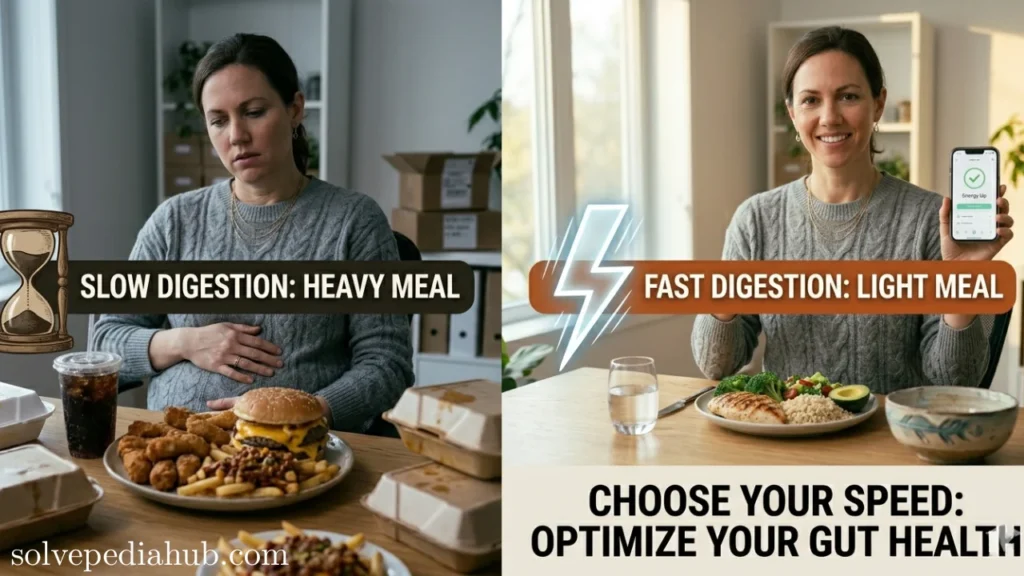
High-fat, high-protein meals — Fat signals the small intestine to release cholecystokinin (CCK), a hormone that deliberately slows gastric emptying to allow proper fat digestion.
Certain medications — According to Cleveland Clinic, these specifically delay digestion:
- Anticholinergics
- Antidepressants
- Diabetes medications
- Oral contraceptives
- Parkinson’s disease medications
- Arthritis medications & antispasmodics
Age — As we age, gastric motility naturally slows. Enzyme production decreases, gut bacteria diversity declines, and GI muscle tone weakens.
Chronic stress — Stress activates the sympathetic nervous system, suppressing the parasympathetic “rest and digest” response. Cortisol diverts blood flow away from the GI tract — making stress one of the most underrecognized causes of slow digestion, IBS, and bloating.
Medical conditions — Gastroparesis, irritable bowel syndrome (IBS), Crohn’s disease, and chronic constipation all significantly slow GI transit.
What Speeds Digestion Up
Physical activity — Even a 15-minute walk after eating stimulates intestinal contractions and accelerates gastric emptying.
Hydration — Water moves food through the entire GI tract. Dehydration thickens stool and slows colonic transit dramatically.
High-fiber diet — Fiber adds bulk, stimulates peristalsis, and feeds the gut microbiome. The American Gastroenterological Association recommends 25–38 grams of fiber daily for healthy adults.
Gender Differences in Digestion Speed
Women digest food measurably slower than men. Colorado State University’s research explicitly states that gender and reproductive status are significant variables in GI transit time.
A landmark study published in *Gut* (Degen LP and Phillips SF, 1996) confirmed that women have longer whole-gut transit times than men — even when controlling for diet, activity level, and body size.
The primary reason is progesterone — a hormone that rises during the second half of the menstrual cycle and throughout pregnancy. It directly inhibits smooth muscle contractions in the GI tract, slowing peristalsis and gastric emptying.
💡 If you’re a woman and you feel consistently more bloated or slower to digest than the men around you — you’re not imagining it. The biology is real.
The Gut Microbiome — The Hidden Factor
Your gut microbiota — trillions of bacteria, fungi, and microorganisms living in your colon — plays a direct role in how fast you digest food.
A diverse, healthy microbiome ferments undigested fiber efficiently, producing short-chain fatty acids that fuel colon cells and regulate transit speed. A disrupted microbiome — from antibiotics or poor diet — can destabilize motility in either direction.
Probiotic-rich foods (yogurt, kefir, kimchi, sauerkraut) and prebiotic fiber (garlic, onions, bananas, oats) support a healthier microbiome and more consistent digestion.
Your Top Digestion Questions — Answered
Where is food 30 minutes after eating?
Mostly still in your stomach. At 30 minutes, simple carbohydrates and liquids may have begun trickling into the small intestine through the pyloric sphincter — the valve connecting the stomach to the duodenum. Most solid food is still being churned with gastric acid and digestive enzymes. Plain water, however, has already been largely absorbed by this point.
What is the 20-minute rule for eating?
It takes approximately 20 minutes for your stomach to send fullness signals to your brain via satiety hormones — specifically leptin (fullness signal) and ghrelin (hunger signal). When you eat too fast, you consume more than your body needs before the signal arrives. Eating slowly, chewing thoroughly, and putting your fork down between bites helps this hormonal system work properly — reducing overeating and improving gastric comfort.
What foods take 30 minutes to digest?
Foods that begin leaving the stomach within 30 minutes include plain water, diluted juices, and simple carbohydrates like plain white rice or dry toast. These have minimal fat, fiber, or protein to slow gastric emptying. Most whole, mixed foods take 2–5 hours just to exit the stomach.
How long until a meal is fully digested?
Full digestion — from mouth to elimination — takes 24 to 72 hours for most healthy adults. The stomach empties in roughly 4–5 hours. The small intestine processes nutrients over 2–6 hours. The colon handles the final stage in 10–59 hours. According to both the NIDDK and Colorado State University research, 30–40 hours is the average colonic transit time.
Can stress really affect how fast you digest food?
Yes — significantly. Stress activates the sympathetic nervous system and suppresses the parasympathetic “rest and digest” response. Cortisol disrupts the gut-brain axis. Chronic stress is clinically linked to IBS, functional dyspepsia, and both accelerated and delayed gut transit.
What happens if food digests too fast or too slow?
Too fast: Nutrients aren’t fully absorbed. The colon becomes overloaded. Diarrhea, dehydration, and long-term malnutrition can result. Dumping syndrome — food moving from the stomach into the small intestine too rapidly — causes nausea, cramping, and blood sugar crashes.
Too slow: Food ferments longer than it should, causing bloating, gas, and constipation. Severe slowing — as in gastroparesis — can cause vomiting, weight loss, and dangerous blood sugar fluctuations.
How do I know if my digestion is healthy?
Healthy digestion typically means: regular bowel movements (3 times per day to 3 times per week is considered normal), no chronic bloating or cramping, formed and easy-to-pass stools, and no persistent pain after eating. The Bristol Stool Chart — developed by the University of Bristol — is a clinically validated tool for assessing stool form as an indicator of GI transit health.
Conclusion
How fast you digest food depends on what you eat, who you are, and how you live.
Simple liquids pass in minutes. A high-fat, high-protein meal can sit in your stomach for 5–8 hours. Full digestion from mouth to elimination takes 24 to 72 hours — a timeline that surprises almost everyone.
Your digestion speed is a window into your metabolic health, gut microbiome, hormonal balance, and nervous system. If it feels consistently off, your gut is trying to tell you something.
Simple habits that support healthy digestion:
- Eat slowly — honor the 20-minute fullness rule
- Drink enough water daily
- Move your body after meals
- Prioritize fiber from whole foods
- Reduce chronic stress
- Know which medications may be slowing your GI motility
When to see a doctor: Persistent bloating, pain after eating, blood in stool, unexplained weight loss, or chronic diarrhea/constipation can indicate gastroparesis, IBS, Crohn’s disease, or celiac disease — all treatable when caught early.
Your gut works hard every single day. Understanding how it works — and how fast — is the first step to giving it what it actually needs.
Sources: NIDDK (National Institute of Diabetes and Digestive and Kidney Diseases), Cleveland Clinic — Dr. Christine Lee MD, Mayo Clinic, Colorado State University VIVO Pathophysiology, Donat (Kristina Aralica Tušak, nutritionist), IMODIUM UK, Gut Journal (Degen LP & Phillips SF, 1996), American Gastroenterological Association, University of Bristol — Bristol Stool Chart.