Three months. That is all some people say you need to go from zero to writing code. But is it actually true — or just a marketing line from coding bootcamps?
The honest answer: yes, you can learn to code in 3 months — but what you learn depends heavily on your goals, your daily hours, and how you define ” Learn Coding in 3 Months.” This guide breaks it all down with no fluff.
What Can You Realistically Learn to Code in 3 Months?
What “Learning to Code” Actually Means — Setting the Right Expectation
“Learning to code” means very different things to different people. For a student, it might mean understanding programming fundamentals. For a career changer, it means being job-ready. For a freelancer, it means building a working product.
In 3 months, you can absolutely learn the core syntax and logic of one programming language, build a handful of real projects, and understand how the web works. What you cannot do in 3 months is master computer science theory, advanced algorithms, or become a senior-level engineer. Setting this expectation correctly is the first step to not quitting.
Key Insight: The goal in 3 months is not mastery. It is functional proficiency — meaning you can build things, solve problems, and show proof of your skills to employers or clients.
Beginner vs. Job-Ready
A beginner understands syntax. A job-ready developer has a portfolio of real projects, can debug their own code, understands version control with Git, knows how to collaborate, and can communicate their problem-solving process in a technical interview.
According to Career Karma, bootcamp graduates who are hired within 3–6 months of completing their program typically have 2–4 portfolio projects and strong fundamentals in at least one stack. That is the real benchmark — not just finishing a course.
Which Programming Languages Are Actually Learnable in 3 Months?
Not all languages are equal for a 3-month timeline. The most beginner-friendly and job-relevant languages to start with are:
• Python — clean syntax, readable, widely used in data science, automation, and web backends
• HTML & CSS — the building blocks of every website; learnable in weeks, not months
• JavaScript — the language of the web; steep at first but extraordinarily versatile
• SQL — used in virtually every company that stores data
Languages like C++, Java, and Rust have steeper learning curves and are not ideal as a first language if your goal is employability within 3 months. According to Noble Desktop, a simple programming language can be learned to basic proficiency in 3 to 6 months — making Python or JavaScript the smartest starting points for a 3-month push.
For more info: Caffeine Effects Timeline: When It Starts, Peaks & Wears Off
The Exact 3-Month Coding Roadmap — Week by Week
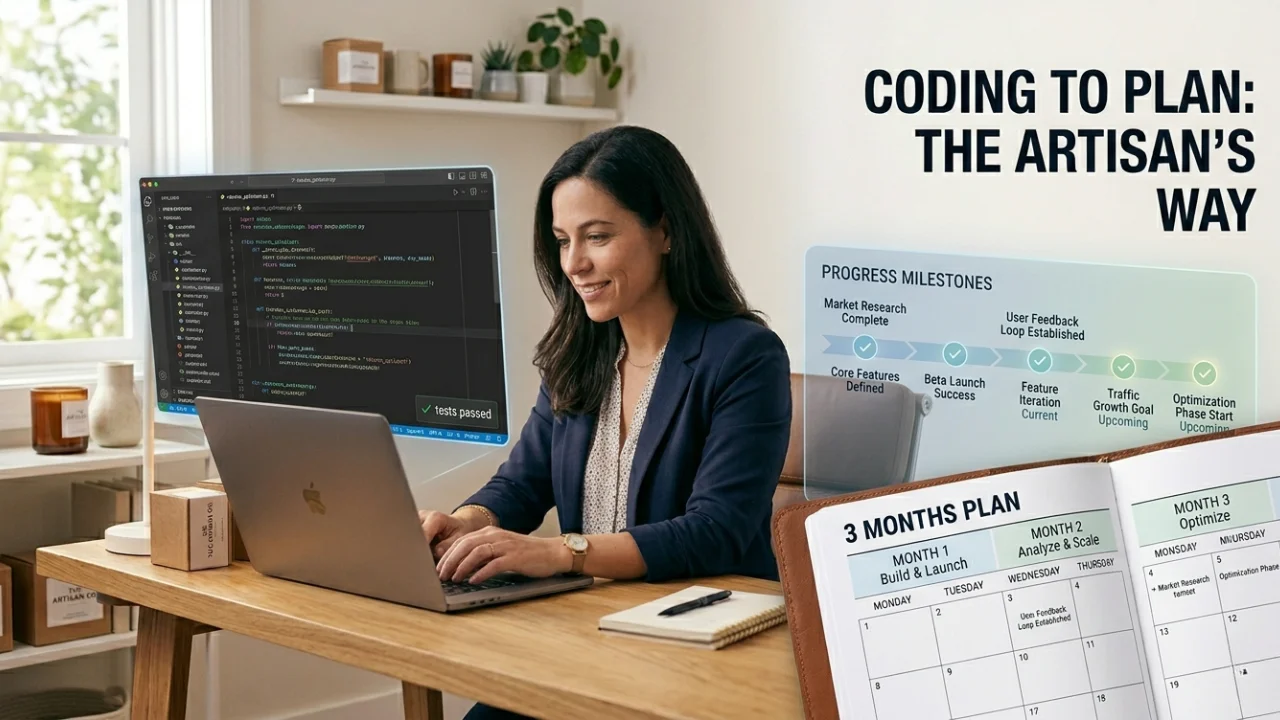
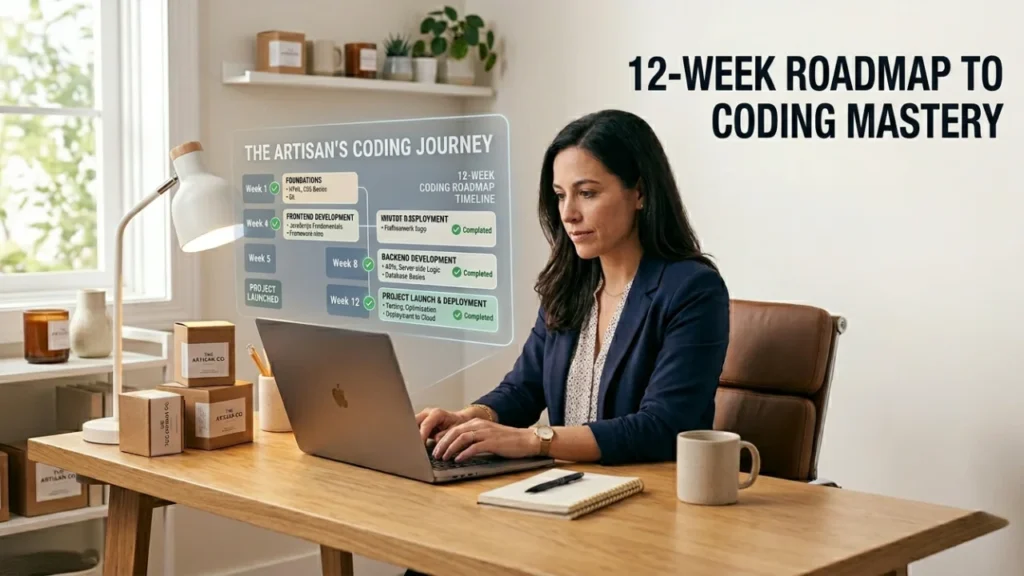
Here is a structured, realistic 3-month coding roadmap based on 3–5 hours of daily study. Adjust hours to your schedule — but do not drop below 2 hours per day if your goal is job readiness.
| Month | Focus Area | Key Skills | Daily Hours |
| Month 1 | Foundations | HTML, CSS, Python/JS basics | 3–4 hrs |
| Month 2 | Projects & Practice | Real builds, debugging, Git | 4–5 hrs |
| Month 3 | Portfolio & Job Prep | Portfolio, interviews, algorithms | 4–6 hrs |
Month 1: Foundations — HTML, CSS, Python or JavaScript Basics
Month 1 is about building your mental model of programming. You are training your brain to think in logic, loops, and conditions. Do not skip this phase or rush it.
Week 1–2: Learn HTML and CSS. Build a basic personal webpage. Understand box model, flexbox, and responsive design. These are not optional — every web developer needs them.
Week 3–4: Start Python or JavaScript. Learn variables, data types, functions, conditionals, and loops. Do not just watch tutorials. Type every line of code yourself. freeCodeCamp and Codecademy are excellent free starting points for this phase.
By end of Month 1, you should be able to write a basic program that takes input, processes it, and returns output. That is a real milestone.
Month 2: Building Real Projects — The Phase That Separates Learners from Developers
This is the most important month. Most beginners stall here because project-based learning is harder than following tutorials. Push through it — this is exactly where real skill forms.
Week 5–6: Build 2 small projects from scratch — a to-do app, a calculator, or a weather app using an API. Learn Git and GitHub for version control. Every employer in the USA looks at your GitHub profile. A blank GitHub is a red flag.
Week 7–8: Start a slightly more ambitious project — a personal portfolio website, a simple e-commerce page, or a data dashboard with Python. Introduce yourself to React (for JavaScript learners) or Django/Flask (for Python learners). You do not need to master these frameworks — just get comfortable.
Pro Tip: Every project you build in Month 2 becomes a portfolio piece. Name your GitHub repositories clearly. Write a README for each project. Future employers will read them.
Month 3: Portfolio, Problem-Solving & Job-Ready Skills
Month 3 is about transition from student to professional. You stop just learning and start preparing to be hired or to take freelance work.
Week 9–10: Polish your top 2–3 projects. Deploy them live using GitHub Pages, Vercel, or Netlify (all free). A deployed project carries 10x the weight of a local project on a resume.
Week 11–12: Start LeetCode or HackerRank for basic algorithm practice. You do not need to solve hard problems — focus on easy and medium-level questions. Practice explaining your thought process out loud. This is what technical interviews test.
Also in Month 3: update your LinkedIn profile, write a developer resume, and begin connecting with people in the tech industry. According to Educative, Josh Kemp — who had zero prior coding experience — landed a junior developer job in under 8 months using a similar structured approach.
How Many Hours Per Day Do You Actually Need?
• 2 hours/day — You will reach basic proficiency in 3 months but likely not job-ready
• 3–4 hours/day — Realistic for most people with a full-time job; job-ready in 4–5 months
• 6–8 hours/day — Bootcamp pace; genuinely job-ready in 3 months for focused learners
According to Codecademy’s learner survey, most job-seekers learning to code spend between 1–3 hours per week at minimum — but those who reach employment typically go far above that. Consistency beats intensity. 3 hours every day beats 8 hours on Saturday.
Factors That Decide If 3 Months Is Enough for You
Two people can follow the exact same 3-month plan and end up in completely different places. Here is why.
Your Daily Time Commitment — The Single Biggest Variable
Time is the single most powerful variable in your coding learning timeline. A person studying 6 hours daily will progress in 3 months what a casual learner covers in a year.
Be honest with yourself about your schedule. If you have a full-time job and two kids at home — like Codecademy learner Elena Gorman — you may only carve out 1–2 hours per day. That is fine. But adjust your expectation: for you, job-ready might take 6–9 months, not 3. Planning around your real life prevents burnout and quitting.
Prior Experience, Learning Speed & Background Knowledge
If you have ever written a formula in Excel, used a spreadsheet with logic, taken a high school computer science class, or dabbled in HTML — you have a head start. These transferable concepts compress your learning curve significantly.
Complete beginners should not be discouraged. They simply need to factor in an extra 2–4 weeks of ramp-up time in Month 1. The learning acceleration happens naturally once the core logic of programming clicks — and for most people, that click moment arrives within the first 3–4 weeks.
Choosing the Right Learning Method — Self-Study vs. Bootcamp vs. Online Courses
Your learning method dramatically affects your 3-month outcome. Here is the honest comparison:
| Method | Timeline | Cost | Best For |
| Self-Study | 6–12 months | Free–$50/mo | Flexible schedules |
| Coding Bootcamp | 3–6 months | $10K–$20K | Fast career change |
| Online Courses | 3–9 months | $15–$500 | Structured + affordable |
| CS Degree | 4 years | $40K–$200K | Deep theory + research |
For a strict 3-month timeline, a full-time coding bootcamp is the most reliable path. Programs like those reviewed on Career Karma report job placement rates between 71% and over 90% with starting salaries between $65,000 and $90,000. If cost is a barrier, structured online platforms like Educative and Codecademy Pro offer guided career paths at a fraction of the price.
The Hidden Factor: Consistency Over Intensity
This is what competitors rarely say plainly: the biggest predictor of success is not how smart you are — it is how consistent you are. Beginners who study every single day — even for just 90 minutes — outperform those who grind 10 hours on weekends and disappear for a week.
The Pomodoro technique — 25-minute focused sessions with 5-minute breaks — is used by countless successful self-taught developers. Tools like Pomofocus.io make it easy to implement. Combine this with the #100DaysOfCode challenge — where you code for at least one hour every day for 100 consecutive days and post your progress publicly — and you have a powerful accountability framework that thousands of self-taught developers have used to reach employment.
What Coding Jobs Can You Get After 3 Months of Learning?
This is what most people really want to know. Can 3 months of coding actually lead to a paycheck? The answer is yes — with the right strategy.
Entry-Level Roles You Can Target — Web Developer, Junior Developer, Freelancer
After a focused 3-month coding learning journey, the most realistic job targets are:
• Junior Front-End Developer — building and styling web interfaces with HTML, CSS, JavaScript
• Junior Web Developer — working on both front and back end of websites
• Freelance Web Developer — building websites for small businesses, the most accessible entry point
• Junior Python Developer — automation scripts, data manipulation, basic back-end work
• Technical Support or QA Tester — entry paths that value coding literacy but don’t require expert-level skills
Full-stack, data science, and machine learning roles typically require 6–12+ months of learning. Do not aim for those straight out of a 3-month sprint. Build credibility at the entry level first.
Realistic Salary Expectations for First-Time Coders in the USA
According to the Bureau of Labor Statistics, the median annual salary for web developers in the USA is over $78,000. Entry-level positions typically start between $45,000 and $65,000 depending on location, stack, and employer.
Freelancers with a strong portfolio can earn $25–$75 per hour from their very first clients — even without a formal job title. Many self-taught developers begin with freelance work to build real-world experience before applying to full-time roles.
What Employers Actually Look For — Portfolio Over Degree
Here is the single most important thing to understand about getting your first coding job: most US tech companies — including startups and mid-size firms — care far more about what you can build than where you studied.
A GitHub profile with 3 deployed, well-documented projects outweighs a blank resume with a coding certificate. Employers want to see that you can solve real problems, write clean code, and push updates via Git. According to Career Karma, portfolio projects are the number one factor cited by hiring managers when evaluating bootcamp and self-taught candidates.
Why Most 3-Month Learners Still Fail the Job Hunt
The majority of people who learn to code in 3 months do not get hired within 3 months. Not because their skills are insufficient — but because they stop too soon. They finish the course, close their laptop, and start applying. Then nothing happens.
The mistake is treating learning and job searching as separate phases. They must overlap. Start applying in Month 3 while still learning. Go to local tech meetups. Contribute to open-source projects on GitHub. Join communities like freeCodeCamp’s forum or coding subreddits. Network genuinely.
The developers who get hired from a 3-month sprint are not necessarily the best coders. They are the most visible, consistent, and persistent ones.
Best Tools, Platforms & Strategies to Learn Coding in 3 Months
The platform you choose shapes your speed and quality of learning. Here are the most effective options for a 3-month sprint.
Top Platforms — freeCodeCamp, Codecademy, Educative, Coursera & More
freeCodeCamp — completely free, project-based, and has earned thousands of developers their first jobs. Its full curriculum is equivalent to roughly 1 year of full-time study, but focused tracks can be completed meaningfully in 3 months.
Codecademy — structured, beginner-friendly, and offers guided career paths for Front-End Engineer, Data Scientist, and more. Their interactive lessons mean you write code from lesson one — not just watch videos.
Educative — text-based, code-as-you-read format. Especially strong for software developer paths and includes an AI mentor that gives hints without giving answers — a powerful learning tool.
Coursera — university-level courses from institutions like Google, IBM, and Meta. The Google IT Support Certificate and IBM Data Science Certificate are highly regarded by US employers.
Noble Desktop — offers in-person and live online classes with small class sizes and the option to retake courses free for one year after completion. Strong for hands-on learners in New York and online.
The 80/20 Rule in Programming — Focus on What Actually Matters
The 80/20 rule in programming — also called the Pareto Principle — states that roughly 80% of your real-world coding output comes from 20% of what you could learn. This is one of the most powerful and underused principles for fast learners.
In practice, this means: master the fundamentals deeply rather than surface-level browsing across many topics. For a web developer, that 20% is HTML/CSS, JavaScript DOM manipulation, one framework (React or Vue), Git, and basic API usage. Everything else can be looked up. Focus your 3 months on that critical 20%.
Application: When you feel tempted to learn a new tool or language mid-journey — stop. Ask: “Does this make me more employable in the next 90 days?” If not, it goes on your “later” list.
The #100DaysOfCode Challenge & Pomodoro Technique for Fast Learning
The #100DaysOfCode challenge was created by developer Alexander Kallaway and has been used by hundreds of thousands of learners worldwide. The rules are simple: code for at least one hour every day for 100 consecutive days and tweet your progress with the hashtag.
What makes it powerful is not the hours — it is the public accountability. When you post daily, you build a visible record of your learning journey. Employers and developers in your network see your growth in real time. Many participants have reported receiving job offers directly from the community they built during the challenge.
Pair this with the Pomodoro technique — 25 minutes of focused coding followed by a 5-minute break — and you eliminate the two biggest enemies of self-taught developers: distraction and burnout. Most people find they can sustain 4–6 Pomodoro sessions per day without mental fatigue, which adds up to 2–3 solid hours of actual productive study.
Using AI as a Learning Co-Pilot
This is the unfair advantage available to every coder learning today that did not exist 5 years ago. AI tools like ChatGPT and GitHub Copilot have fundamentally changed how fast beginners can learn to code — and almost no one is talking about it seriously in the context of beginner learning.
Use AI not to write code for you — but as a 24/7 personalized tutor. Stuck on a bug? Ask AI to explain what is wrong — not fix it. Don’t understand why a function works? Ask AI for five different analogies until one clicks. Need a code review? Paste your code and ask for specific feedback.
Educative’s platform has already integrated an AI mentor that nudges learners toward solutions without giving direct answers — a pedagogically proven method. Using AI this way compresses what used to take weeks of Stack Overflow searching into minutes of targeted learning. For a 3-month timeline, this advantage is not optional — it is essential.
FAQ — Your Top Coding Questions Answered
Is coding difficult to learn?
Coding is not inherently difficult — but it does require a different way of thinking that takes time to develop. The first 2–4 weeks feel confusing because your brain is building new mental models for logic, abstraction, and problem decomposition. After that initial phase, most learners report that progress feels steadily more natural. According to Career Karma, coding is not hard to learn — but it does demand consistent practice. The people who say coding is “too hard” typically stopped too early, before the logic patterns became intuitive.
Did Elon Musk know how to code?
Yes. Elon Musk taught himself to code as a child with no formal instruction. By age 12, he had written and sold his first video game — a space-themed game called Blastar — for approximately $500. He learned from a book and taught himself BASIC programming language in just three days, a process that the manual said would take six months. Musk’s story is often cited as proof that self-taught coding is not only possible but can be remarkably fast when motivation is high. He has since said that while he is not a professional programmer, his coding foundation was essential to understanding and leading technical teams at companies like SpaceX and Tesla.
What is the 80/20 rule in programming?
The 80/20 rule in programming refers to the observation that approximately 80% of the results in software development come from 20% of the available knowledge and tools. In practical terms, a small set of core programming concepts — variables, functions, loops, conditionals, data structures, and APIs — power the vast majority of real-world applications. For beginners, applying the 80/20 rule means mastering fundamentals deeply before jumping to frameworks, libraries, or advanced topics. It also means focusing on the specific skills most relevant to your target job role rather than trying to learn everything. This principle is especially powerful for 3-month coding learners because it forces prioritization — the skill that separates people who finish from people who get overwhelmed and quit.
How quickly can I learn coding?
The speed at which you learn to code depends on three things: how many hours per day you study, which language you start with, and your learning method. According to data from Educative and Career Karma, the general ranges are: 3–6 months for basic proficiency in a beginner-friendly language, 3–6 months for a coding bootcamp to job-ready level, and 6–12 months for self-study to reach employment. The fastest documented self-taught developers reached entry-level employment in 3–4 months by studying 6–8 hours daily, building projects from week one, and networking aggressively throughout.
Conclusion
Yes — you can learn coding in 3 months. But what you achieve depends entirely on how you define success, how many hours you put in each day, and whether you focus on building real things rather than just completing courses.
Three months of consistent, project-driven, focused coding can get you to a genuine entry-level skill set. Pick one language. Build real projects. Push your code to GitHub. Start networking on day one. Use AI as your tutor. And never stop for more than 48 hours.
The developers who get hired do not have the most talent. They have the most discipline, visibility, and persistence. Those three things are entirely within your control — starting today.