You drank coffee three hours ago. You still feel wired. Sound familiar? Most people have no idea how long caffeine actually stays active in the body — or why that afternoon espresso is still ruining their sleep at midnight.
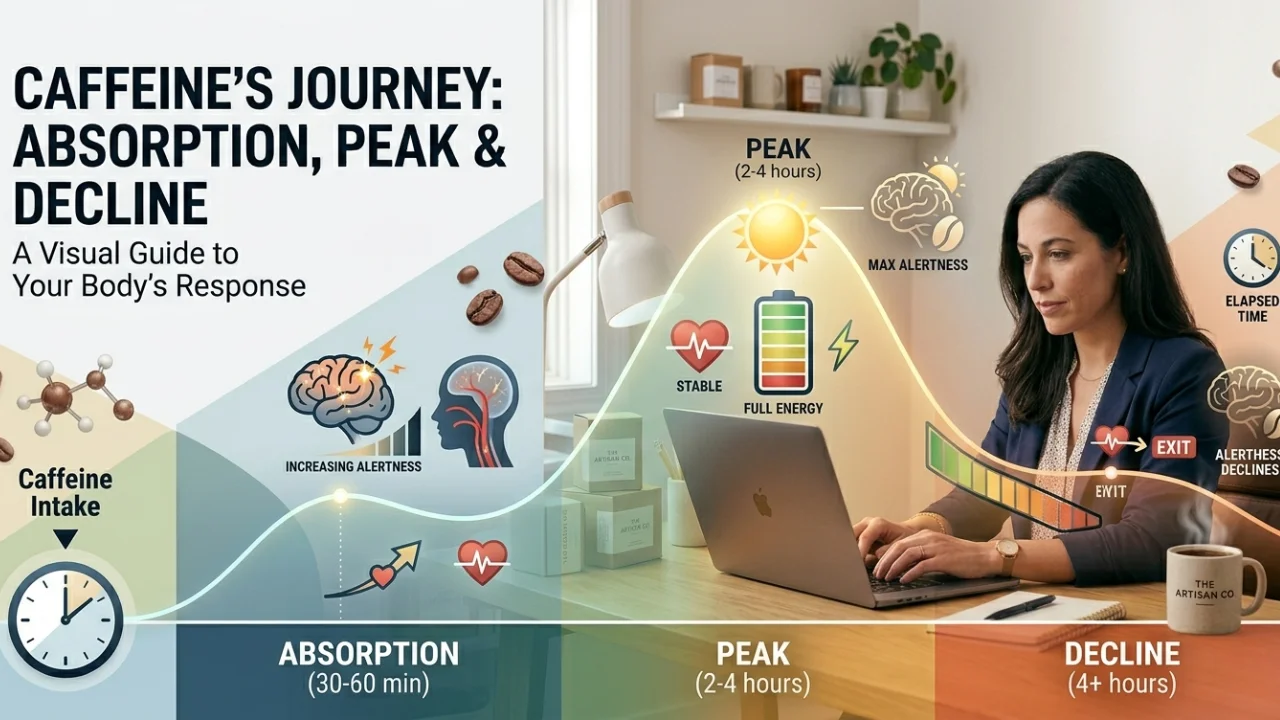
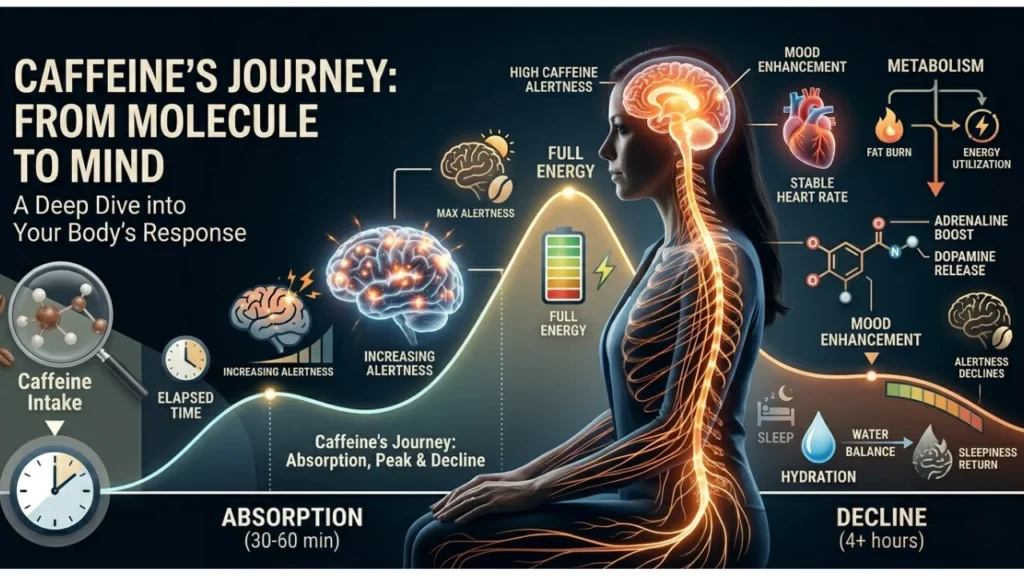
This guide breaks down the complete caffeine effects timeline — minute by minute — so you know exactly when caffeine starts working, when it peaks, and how long it takes to fully wear off.
How Caffeine Works in Your Body — The Science Behind the Timeline
Before we look at the timeline, you need to understand why caffeine does what it does. It is not magic. It is chemistry.
What Caffeine Actually Does to Your Brain — Adenosine Blockage Explained
Your brain constantly produces a chemical called adenosine. It is the molecule responsible for making you feel sleepy. Throughout the day, adenosine accumulates and gradually increases your sleep pressure — the biological urge to rest.
Caffeine is structurally similar to adenosine. So it sneaks into the same receptor sites and blocks adenosine from binding. According to Houston Methodist, this is why caffeine keeps you alert — it does not give you energy directly. It simply suppresses the signal that tells your brain it is tired.
Once caffeine wears off, all that blocked adenosine floods back in — which explains the infamous caffeine crash. It was never gone. It was waiting.
How Fast Caffeine Is Absorbed — From First Sip to Bloodstream
Caffeine is absorbed through the gastrointestinal tract with remarkable speed. It has very high bioavailability — meaning nearly all of what you consume is taken up by your body.
According to the Sleep Foundation, you can begin to feel effects in as little as 15 minutes after consumption. Within 45 to 60 minutes, caffeine reaches its peak concentration in the bloodstream. This is when focus sharpens, mood lifts, and — for some people — the jitters kick in.
The Half-Life of Caffeine — What It Really Means for You
The half-life of caffeine is the time it takes for your body to eliminate half of the caffeine you consumed. According to the FDA, this is typically four to six hours for most healthy adults.
So if you drink a 200 mg coffee at 2 PM, roughly 100 mg is still active at 7 or 8 PM. And about 50 mg is lingering past midnight. That is not nothing — especially if you are sensitive to caffeine or struggling to fall asleep.
Important: The half-life range is actually 2 to 12 hours depending on individual factors. This is why the same afternoon coffee knocks one person out at 3 AM and does not bother another person at all.
For more info: How Fast Do You Digest Food? (What Most People Don’t Know)
The Caffeine Effects Timeline — Minute by Minute Breakdown
This is what is actually happening inside your body after every cup of coffee, tea, or energy drink. Most articles give you vague ranges. Here is the precise breakdown.
| Time | What’s Happening | How You Feel | Key Phase |
| 0–15 min | Absorbed into bloodstream | Slightly alert | Absorption |
| 30–60 min | Peak blood concentration | Full energy & focus | Peak Effect |
| 1–5 hrs | Half-life begins; liver metabolizes | Sustained energy, possible jitters | Active Window |
| 5–6 hrs | 50% still in system | Alertness declining | Half-Life |
| 10+ hrs | Near-complete clearance | Effects mostly gone | Clearance |
0–15 Minutes: What Happens Right After You Drink Caffeine
The moment caffeine enters your digestive system, absorption begins. Within 15 minutes, measurable amounts enter your bloodstream. You may not feel much yet — just a subtle shift in alertness.
At this stage, your heart rate may tick up slightly and blood vessels begin to narrow. Your liver starts producing enzymes — specifically CYP1A2 — that will eventually break caffeine down. This enzyme activity varies dramatically between individuals, which is exactly why caffeine hits people so differently.
30–60 Minutes: When Caffeine Peaks in Your System
This is the peak caffeine window. Blood concentration is at its highest. Adenosine receptors in your brain are maximally blocked.
You feel it clearly: sharper focus, elevated mood, improved reaction time, and for athletes, measurably better endurance. According to WebMD, caffeine also triggers the release of adrenaline, which elevates blood pressure and prepares your body for heightened activity.
This is also when caffeine sensitivity becomes most apparent. People with low tolerance may experience jitteriness, anxiety, or rapid heartbeat at this stage — especially if their dose was too high for their body weight or tolerance level.
1–5 Hours: The Sustained Energy Window (And When the Crash Hits)
For most people, the active stimulant window lasts roughly 3 to 5 hours. This is the phase where caffeine is doing its real work — keeping adenosine suppressed and your central nervous system (CNS) stimulated.
Around the 3–4 hour mark, metabolism accelerates. Your liver is actively breaking down caffeine into metabolites including paraxanthine, theobromine, and theophylline — each with mild stimulant properties of their own. This is why the energy does not vanish instantly. It fades gradually.
The caffeine crash — that sudden dip in energy — typically arrives here. It is not caffeine itself causing the crash. It is the sudden re-flooding of adenosine receptors once caffeine clears them. If you grabbed a second coffee right now, you would feel sharp again. Which is exactly how caffeine dependency builds.
5–10+ Hours: Why Caffeine Is Still in Your Body Long After You Feel It
This is the phase most people completely ignore — and it is the reason they cannot sleep.
At the 5-hour mark, roughly half your caffeine is still active. At 10 hours, most healthy adults have cleared the majority — but not all. People with slower caffeine metabolism may still have significant amounts circulating at the 10-hour mark.
According to Healthline, caffeine may not fully clear your bloodstream for up to 10 hours or more. Even if you do not feel awake, caffeine is still disrupting your sleep architecture — suppressing deep slow-wave sleep and REM quality without you realizing it.
Factors That Change Your Personal Caffeine Timeline
Two people drink the same coffee. One is asleep by 10 PM. The other is staring at the ceiling at 2 AM. Here is why the caffeine timeline is not the same for everyone.
Age, Body Weight, and Genetics
Older adults tend to metabolize caffeine more slowly. As the liver ages, CYP1A2 enzyme activity decreases, extending caffeine’s half-life. A 60-year-old may process caffeine 50% slower than a healthy 25-year-old.
Body weight also plays a role — not through fat mass, but through lean body mass and liver size. Larger individuals with more metabolically active tissue tend to clear caffeine faster.
Genetics is the biggest wildcard. The CYP1A2 gene determines whether you are a fast or slow caffeine metabolizer. Slow metabolizers carry a genetic variant that extends caffeine’s half-life significantly — meaning that single afternoon cup lingers well into the night for them, while fast metabolizers clear it quickly.
Pregnancy, Medications, and Medical Conditions
Pregnancy dramatically slows caffeine metabolism. According to Healthline, the caffeine half-life during pregnancy can extend to 15 hours or more — nearly three times the normal rate. This is why guidelines recommend limiting intake to 200 mg per day during pregnancy.
Certain medications interact with caffeine metabolism. Oral contraceptives, some antibiotics like ciprofloxacin, and specific antidepressants can all slow the CYP1A2 enzyme, keeping caffeine active longer. Conversely, smoking cigarettes speeds up the enzyme — which is why smokers often report needing more caffeine to feel its effects.
Liver disease and conditions like hypothyroidism can also reduce clearance rates, making caffeine linger far longer than expected.
Caffeine Tolerance — Why Regular Drinkers Feel It Differently
Daily caffeine users develop pharmacological tolerance relatively quickly — sometimes within a few days of consistent use. The brain adapts by upregulating adenosine receptors, meaning it creates more binding sites to compensate for the ones caffeine blocks.
The result? You need more caffeine to get the same effect. But here is what is critical: tolerance affects the perceived effect, not the half-life. Regular drinkers still have caffeine in their system just as long — they just do not feel it as strongly. Their sleep is still being disrupted even when they feel unaffected.
Hidden Variables Competitors Miss — Altitude, Smoking & Liver Enzymes
Here is what most caffeine articles never mention. High altitude affects caffeine metabolism because lower oxygen levels change liver enzyme activity. People at elevations above 8,000 feet often report caffeine feeling stronger and lasting longer — a real phenomenon that is rarely discussed.
As mentioned, smoking is a significant accelerator of caffeine metabolism. Smokers clear caffeine up to 50% faster than non-smokers — which partly explains why smokers are often heavier coffee drinkers. When smokers quit, caffeine suddenly lasts much longer and can cause increased jitteriness and anxiety, which is often mistaken for nicotine withdrawal.
Eating before caffeine consumption also slows absorption. A full stomach delays the caffeine peak by 30 to 60 minutes — useful if you want sustained energy without the sharp spike.
Caffeine and Sleep — How Late Is Too Late?
This is the question everyone wants answered. And the honest truth is: it depends on you. But science gives us very useful guidelines for the caffeine and sleep relationship.
How Caffeine Disrupts Deep Sleep and Circadian Rhythm
Caffeine does not just delay sleep onset. It actively degrades sleep quality even after you fall asleep. Research shows caffeine reduces slow-wave deep sleep (N3) — the most restorative phase — by suppressing adenosine pathways that help initiate this stage.
According to the Sleep Foundation, caffeine also interferes with your body’s circadian rhythm by delaying the natural rise of melatonin — the hormone that signals nighttime to the brain. Even when caffeine does not feel like it is keeping you awake, it may be reducing the restorative depth of your sleep without you knowing it.
The 2 PM Cutoff Rule — Is It Really For Everyone?
Houston Methodist’s Dr. Rashad Ramkissoon recommends a 2 to 3 PM caffeine cutoff for people on standard working hours with a 10 PM bedtime. This is based on the FDA’s 4–6 hour half-life.
But is it universal? No. The American Academy of Sleep Medicine recommends avoiding caffeine at least six hours before bedtime. The Sleep Foundation goes further — recommending eight hours before sleep for sensitive individuals.
Practical Rule: If your bedtime is 11 PM and you are caffeine-sensitive, your last cup should be no later than 1–2 PM. If you are a fast metabolizer, 3–4 PM may be fine. Know your body.
How Much Caffeine Is Actually Safe Per Day — 400 mg Rule Explained
The FDA states that up to 400 mg of caffeine per day is generally safe for healthy adults. That is roughly four 8-ounce cups of brewed coffee.
For context:
| Source | Serving Size | Caffeine (mg) |
| Brewed Coffee | 8 oz | 70–140 mg |
| Espresso | 1 oz | 40–64 mg |
| Black Tea | 8 oz | 25–48 mg |
| Energy Drink | 8–16 oz | 50–300 mg |
| Soda (Cola) | 12 oz | 34–70 mg |
| Decaf Coffee | 8 oz | 3–12 mg |
| Dark Chocolate | 100g | 50–125 mg |
Pregnant individuals should stay under 200 mg daily. Adolescents should avoid caffeine altogether according to the American Academy of Pediatrics. And people with anxiety disorders, heart arrhythmias, or acid reflux should consult a doctor before consuming regular caffeine.
Hidden Caffeine Sources Keeping You Awake Without You Knowing
This is the part most people miss. Caffeine is not just in your coffee. It hides in places you would never think to check.
• Decaf coffee — still contains 3–12 mg per 8 oz cup
• Dark chocolate — up to 125 mg per 100g serving
• Pre-workout supplements — often 150–300 mg per scoop
• Certain pain medications (Excedrin, Midol) — 65 mg per tablet
• Guarana, yerba mate, matcha — naturally high in caffeine
• Energy drinks mixed with alcohol — dangerous combination that masks caffeine’s stimulant effects
According to WebMD, caffeine toxicity threshold is around 1,200 mg — most commonly reached through caffeine powder or concentrated supplements, not regular beverages. Still, stacking hidden sources across the day is more common than people realize.
Caffeine Withdrawal — What Happens When It Wears Off
If you drink caffeine daily, stopping is not simple. Your brain has physically adapted to its presence. Removing it triggers a real, documented withdrawal syndrome with a predictable timeline.

Withdrawal Symptoms Timeline — 12 to 96 Hours After Your Last Cup
12–24 hours: The first signs appear. The most common — and often most severe — is a throbbing headache. This happens because without caffeine blocking adenosine receptors, blood vessels in the brain dilate rapidly. Fatigue, irritability, and difficulty concentrating follow closely.
24–48 hours: Peak withdrawal. This is when symptoms are most intense. Depression, anxiety, nausea, and muscle fatigue are reported. Some people describe it as feeling flu-like.
48–96 hours: Gradual resolution. For moderate caffeine users (1–3 cups per day), symptoms typically resolve within 2 to 4 days. According to Healthline, heavy users may experience symptoms for up to 7 to 10 days.
How to Cut Caffeine Without the Crash
The only proven method to avoid severe withdrawal is a gradual reduction strategy. Cutting 10–25% of your total daily intake every 1–2 weeks allows your brain to slowly downregulate adenosine receptors without the shock of sudden removal.
Practical steps:
• Replace one daily coffee with green tea (lower caffeine, similar ritual)
• Shift to half-caf coffee blends as an intermediate step
• Stay well hydrated — dehydration worsens headaches
• Maintain consistent sleep and wake times to support natural adenosine regulation
• Avoid replacing caffeine with sugar — the energy crash will be similar
Can You Speed Up Caffeine Clearance? The Honest Answer
Here is something most articles will not tell you plainly: you cannot significantly speed up caffeine clearance. Your liver processes it at a genetically determined rate.
However, certain actions can help offset the side effects of too much caffeine:
• Drink water — caffeine is mildly diuretic; staying hydrated reduces jitteriness
• Light movement or a walk — exercise uses up adrenaline caffeine has released
• L-theanine — an amino acid found in green tea that blunts caffeine’s anxious edge without reducing alertness
• Eat a balanced meal — slows ongoing absorption if you recently consumed caffeine
What does not work: cold showers, extra water, sleep, or any supplement claiming to “flush” caffeine. The liver sets the pace. Patience is the only real answer.
FAQ — Your Top Caffeine Questions Answered
How long does it take for caffeine to wear off completely?
For most adults, caffeine takes 8 to 10 hours to largely clear the bloodstream. However, full elimination can take longer depending on your metabolism, genetics, age, and medications. The FDA-cited half-life of 4–6 hours means half is still present after that window. Those with slow CYP1A2 enzyme activity may not fully clear a single cup for 12 hours or more.
Does caffeine reduce the risk of dementia?
This is an emerging area of research. Several observational studies suggest a potential neuroprotective association between regular, moderate caffeine consumption and a reduced risk of Alzheimer’s disease and Parkinson’s disease. Caffeine’s role in blocking adenosine A2A receptors in the brain may reduce neuroinflammation. However, current research is associational — not causal. No medical authority recommends drinking caffeine specifically to prevent dementia. Speak with your doctor about brain health strategies backed by stronger evidence.
How long will 200mg of caffeine keep me up?
At the standard half-life of 5 hours: after 5 hours, 100 mg is still active. After 10 hours, about 50 mg remains. So 200 mg consumed at 2 PM could still have 50 mg circulating at midnight. For most people, 200 mg will produce noticeable alertness for 4 to 6 hours and residual stimulant activity for up to 10 hours. People with caffeine sensitivity may feel disrupted sleep well into the night from a single 200 mg dose taken in early afternoon.
What is the 2 hour coffee rule?
The 2-hour coffee rule refers to a timing strategy recommended by some sleep and productivity experts: wait 90 to 120 minutes after waking up before consuming your first caffeine. The reason is biological. Cortisol — your body’s natural alertness hormone — peaks in the first 30 to 90 minutes after waking. Drinking caffeine during this cortisol spike wastes the dose and builds tolerance faster. Waiting until cortisol begins to dip means caffeine is working when you actually need it most, producing better and longer-lasting focus without the mid-morning crash.
Conclusion
Caffeine starts working within 15 minutes, peaks at 30–60 minutes, and takes up to 10 hours or more to fully clear your system. The half-life is 4–6 hours for most people — but genetics, age, pregnancy, medications, and even altitude can stretch or shrink that window significantly.
Understanding your personal caffeine effects timeline is not about fear — it is about timing. Use caffeine when it works for you. Respect the window. Protect your sleep. And know that the afternoon cup you barely noticed might be the exact reason you are still awake at midnight.