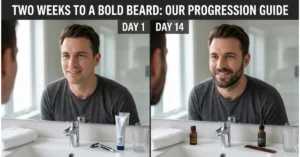
Can you grow a beard in 2 weeks? The short answer is yes — but not the beard you’re imagining. Two weeks gives you real, visible facial hair. It just won’t be a full beard yet.
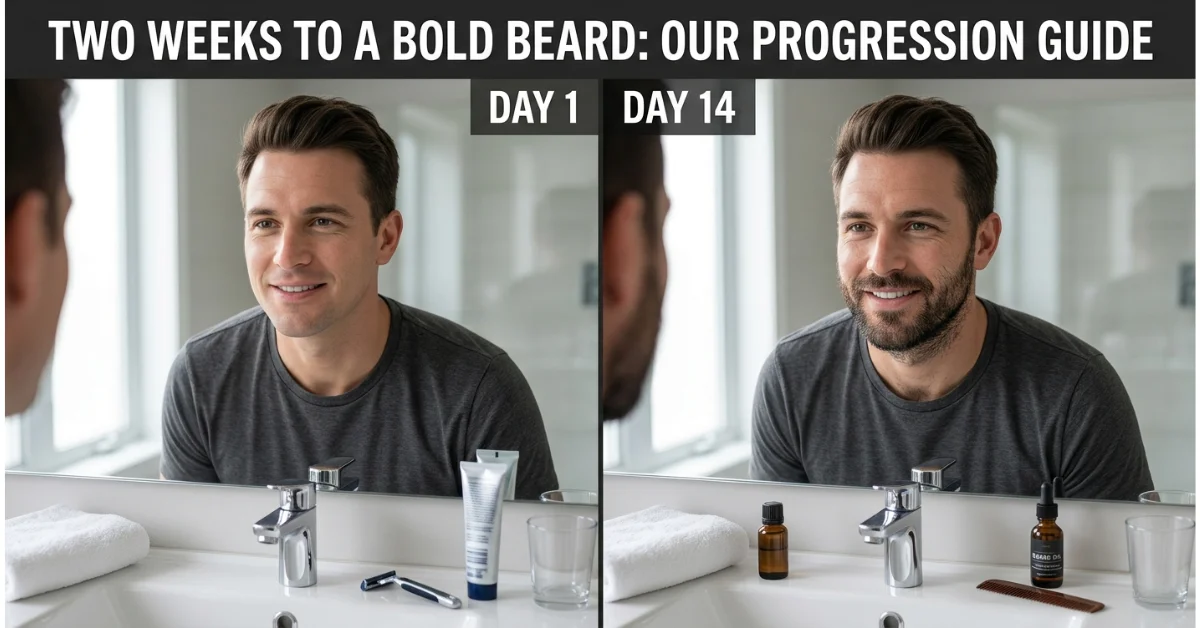
What actually grows in those 14 days depends on your testosterone levels, DHT sensitivity, genetics, and how well you treat your body. Here’s the honest, science-backed breakdown of what happens — day by day.
What Actually Happens to Your Beard in 2 Weeks
Most men have no idea what to expect when they put down the razor. Here’s what’s really going on — from day one to day fourteen.
Days 1–3: The Five O’Clock Shadow Phase
The moment you stop shaving, your hair follicles get to work. Existing hair — which was cut at skin level — begins pushing through the surface. You’ll feel roughness immediately.
This is your five o’clock shadow becoming a full-face situation. The skin may feel coarse, even irritating to touch. That sandpaper sensation is completely normal. Your sebum glands haven’t yet adjusted to the new hair demand.
By day 3, most men have visible stubble of roughly 0.3–0.5mm per day — the scientifically documented facial hair growth rate according to [Healthline](https://www.healthline.com/health/how-to-grow-a-beard).
Days 4–7: Beard Itch Begins — Here’s Why
This is the stage where most men tap out. The beard itch hits hard between days 4 and 7.
Here’s the biology: your skin produces sebum — a natural oil — to keep both your skin and new hair moisturized. But hair growth outpaces sebum production at this stage. Your skin dries out. The sharp, freshly cut hair tips poke back into the skin. The result? Itch, irritation, and redness.
Beard oil — used daily from day one — replaces lost sebum and eliminates most of this discomfort. Brands like Beardbrand and Live Bearded built their entire product lines around solving exactly this problem. Don’t wait until week two to start using it.
Week 2: What Your Beard Really Looks Like at Day 14
By day 14, most men have between 6–10mm of facial hair — roughly a quarter to half an inch. This is past stubble territory. It’s early-stage beard growth.
The anagen phase (the active hair growth cycle) is in full swing. Hair follicle cells are dividing rapidly, producing the keratin-based hair shaft that forms your beard.
But here’s the honest reality that Beardbrand both confirms: at two weeks, patchiness is visible, normal, and not a sign of permanent thin growth. Your follicles are not synchronized — some are in anagen, others in catagen or telogen. Uneven growth at week two tells you nothing about your final beard.
What most people won’t tell you: Week two is the peak psychological frustration point. The comparison trap kicks in. You see someone else’s thick beard online and assume yours is defective. It isn’t. You’re simply mid-process.
For more info: How Fast Do Gym Results Show? 30, 60 & 90 Day Breakdown
Why Your Beard Growth Speed Is Not Fully in Your Control
Why does the beard grow faster for some men? The answer lives inside your biology — specifically your hormones and the DNA you inherited.
Testosterone, DHT, and the Enzyme Behind It All
Two hormones control your beard growth rate: testosterone and dihydrotestosterone (DHT).
Here’s how it works. Testosterone is converted into DHT by an enzyme called 5-alpha-reductase. DHT is the more potent androgen — it binds directly to androgen receptors in your hair follicles and signals them to produce thicker, coarser, darker facial hair.
According to Beardbrand’s hormone research, Higher DHT levels generally produce a thicker, faster-growing beard — but only if your follicles are sensitive to it. Follicle sensitivity to androgens is determined almost entirely by genetics.
Genetics, Age, and Ethnicity — The Real Timeline Shapers
Is beard growth genetic? Largely yes. The density of your hair follicles, how sensitive they are to DHT, and your natural growth pattern are all inherited traits.
Age matters too. According to [Wahl USA](https://wahlusa.com/expert-advice/beard-mustache-trimming/how-long-does-it-take-to-grow-a-beard), most men don’t reach peak beard density until their mid-to-late 20s. Some don’t hit full growth potential until 30 or beyond.
Ethnicity also plays a measurable role. Research shows men of Mediterranean and Middle Eastern descent tend to grow denser facial hair faster. Men of East Asian descent often have finer, slower-growing facial hair due to differences in androgen receptor sensitivity — not lower testosterone levels.
The Hidden Beard Killer: Cortisol
Does stress affect beard growth? Yes — and this is what competitors almost never cover.
When you’re chronically stressed, your body produces elevated cortisol. Cortisol directly suppresses testosterone synthesis. Lower testosterone means less DHT. Less DHT means slower, thinner facial hair growth.
According to research cited by [One Society Men’s Blog](https://onesociety.co.uk/en-us/blogs/mens-blog-uk/beard-growth-tips), sleep deprivation alone can drop testosterone by up to 15% after just one week. That’s one week of bad sleep visibly slowing your beard — a fact almost no grooming blog mentions.
Can You Speed Up Beard Growth in 2 Weeks? (Honest Answer)
Can you make your beard grow faster in 2 weeks? You can optimize conditions. You cannot override genetics. Here’s what actually moves the needle — and what doesn’t.
Nutrition That Feeds Your Follicles
Your hair follicles are among the most metabolically active cells in your body. They need fuel.
- Biotin (Vitamin B7): Strengthens keratin production — the protein your beard is made of. Aim for 5,000–10,000 mcg daily. Found in eggs, nuts, and whole grains.
- Zinc: Supports testosterone production and androgen receptor function. Low zinc = slower beard. Sources: red meat, pumpkin seeds, chickpeas.
- Vitamin D: Optimizes the anagen phase of the hair growth cycle. Many American men are deficient. Get tested before supplementing.
- Omega-3 Fatty Acids: Reduce scalp and skin inflammation. Keep the follicle environment healthy. Sources: salmon, sardines, flaxseed.
- Protein: Your beard is keratin. Keratin is a protein. Without adequate daily protein, muscle protein synthesis and hair production compete for the same resources. Aim for 0.7–1g per pound of bodyweight.
Sleep, Exercise, and the Testosterone Connection
Testosterone and growth hormone peak during deep sleep. This is when your body signals follicles to grow. Skip sleep, and you’re literally cutting off beard fuel.
Aim for 7–9 hours per night. This isn’t a lifestyle tip — it’s follicle biology. As Live Bearded confirmed in their 100-day beard journey, sleep was the single most impactful daily variable in growth consistency.
Resistance training — squats, deadlifts, bench press — raises baseline testosterone by 15–20% according to published exercise science data. More testosterone = more DHT conversion = more active hair follicle signaling. A consistent gym routine is genuinely a beard growth strategy.
Beard Oil, Derma Rollers, and What Actually Works Early
Beard oil doesn’t grow hair from nothing. But it creates the optimal skin environment for follicles to thrive. It replaces lost sebum, prevents beard itch, reduces inflammation, and keeps the skin under new growth healthy. Use it from day one — not week three.
Derma rolling (microneedling) is an advanced technique most blogs skip entirely. A 0.5mm derma roller used once weekly creates micro-injuries in the skin that trigger a healing response. This response increases blood circulation to the follicle area and may activate dormant follicles in patchy zones. Results appear after 6–8 weeks of consistent use.
Minoxidil for beard growth is used off-label by thousands of men in the USA. Originally a hair-loss medication, clinical evidence suggests it can stimulate facial hair follicle activity in men with sparse growth. This is one of the most searched yet least covered topics in beard content. Always consult a dermatologist before use.
The 2-Week Beard: How to Groom, Shape, and Make It Look Its Best
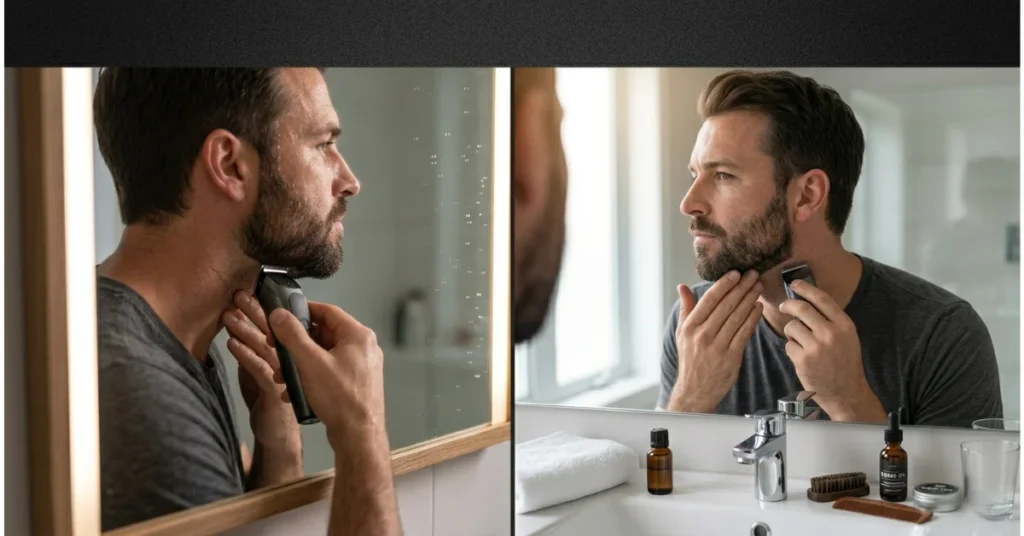
A 2-week beard doesn’t have to look messy. With the right approach, it can look intentional, clean, and sharp. Here’s how.
Start Beard Oil on Day One — Not Week Two
Every expert source — from Beardbrand to Beardburys agrees on this: beard oil application should start the moment you stop shaving.
Apply 3–5 drops to your palm, rub your hands together, and massage into the skin beneath the new growth. This keeps sebum levels balanced, prevents beard itch, and softens new hair so it lies flat rather than spiking outward.
The Neckline Rule That Changes Everything
Where should your beard neckline be at 2 weeks? Place two fingers above your Adam’s apple. That’s your neckline. Everything below gets cleaned up. This single grooming move transforms a messy two-week growth into a purposeful beard.
Use a Wahl beard trimmer or similar tool to define this line. Don’t trim the beard itself — just the neckline. Trimming the beard body at two weeks sets your length back significantly.
The Cheek Line and Face Shape Factor
Your cheek line matters at week two. If the hair grows high onto the cheekbones without a defined line, it creates a shapeless, heavy look. A light cleanup along the cheek line — using a trimmer on the lowest setting — frames your face immediately.
Face shape determines which early beard style suits you best. Square faces look great with a tight, even two-week growth. Oval faces can carry almost any length. Round faces benefit from keeping the sides tighter while letting the chin grow slightly longer — even at two weeks, this subtle shaping creates visual length.
As Wahl USA advises, use a boar bristle brush during early growth. The bristles stimulate circulation at the follicle level and train new hairs to grow in a consistent direction, which makes the beard look fuller and neater from the very beginning.
Common 2-Week Beard Problems and How to Fix Them
Almost every man hits at least one of these problems in the first two weeks. Here’s what’s causing them — and how to handle each one.
Patchy Beard at 2 Weeks — Is It Permanent?
Why is my beard patchy at 2 weeks? Because your hair follicles are not synchronized. Some are in the anagen (growth) phase, some in catagen (transition), and some in telogen (resting). This creates uneven coverage that looks patchy but is almost always temporary.
According to Strut Health’s beard growth research, most patchy areas fill in significantly by months 3–4 as follicles cycle into synchronized growth. Quitting at two weeks because of patchiness is the single most common — and most avoidable — beard mistake.
What actually helps patchy beard growth: Derma rolling, consistent beard oil use, adequate protein and biotin intake, and simply giving it more time. The Beard Club confirms that patience outperforms every product when it comes to filling in patches.
Beard Itch — The Science and the Solution
Beard itch is not random irritation. It’s a sebum depletion response. Your skin can’t produce enough natural oil to simultaneously hydrate your skin and coat every new hair shaft growing through it.
The fix is straightforward: beard oil daily, starting from day one. Jojoba oil and argan oil — both common beard oil bases — are chemically similar to human sebum. They absorb quickly, don’t clog pores, and immediately reduce the itch response. This is why brands like Live Bearded and Beardbrand lead with beard oil as their hero product.
Skin Dryness, Flaking, and Ingrown Hairs
As new hair pushes through the skin surface, some hair follicle openings get partially blocked. This causes ingrown hairs — hairs that curl back into the skin instead of growing outward. They appear as small red bumps and can be painful.
Prevention: exfoliate the skin 2–3 times per week using a gentle facial scrub. This clears dead skin cells from around the follicle openings. Use a beard shampoo (not regular shampoo) to wash the growing hair — regular shampoo strips too much natural oil and worsens dryness.
The Psychological Side
Beard anxiety is real — and it’s the most underreported two-week beard problem.
Social pressure, comments from others, and the endless scroll of perfectly groomed beards on social media create unrealistic expectations. Most men comparing their day-14 beard to someone else’s 6-month beard are comparing incomparable stages.
The data from Reddit’s r/beards community and Quora beard threads consistently shows one thing: the men who push through the first two weeks almost always report that the final result was worth it. The ones who shave early almost always regret it. The awkward phase is not a dead end. It’s the gate every full beard has to walk through.
FAQ: Your 2-Week Beard Questions Answered
Q: What should a 2-week beard look like?
A: At two weeks, your beard should have 6–10mm of growth — past stubble but not yet a full beard. It will look uneven in places, potentially patchy on the cheeks, and thicker around the chin, mustache, and sideburn areas. This is completely normal. The anagen phase is still synchronizing your follicles. A clean neckline and consistent beard oil use will make a 2-week beard look intentional and well-maintained rather than unkempt.
Q: Does a beard attract girls?
A: Research says yes — with nuance. A 2013 study published in Evolution & Human Behavior found that women rated men with heavy stubble (approximately 10 days of growth) as the most attractive for short-term relationships, while full beards were rated highest for long-term relationship potential. The key takeaway: grooming matters more than length. A clean, shaped 2-week beard is more attractive than an unkempt 3-month one.
Q: Is the 3-month beard rule real?
A: Yes — and it’s grounded in genuine beard growth biology. The 3-month rule means committing to zero trimming for 90 days to allow all facial hair follicles to cycle through the anagen phase and reach their natural length. This gives you an accurate picture of your beard’s true density and growth pattern before making any style decisions. Beardbrand and The Beard Club both endorse this approach for first-time growers.
Q: Is it possible to grow a beard after 25?
A: Absolutely. In fact, many men don’t reach their peak beard growth potential until their late 20s or early 30s. Testosterone levels typically stabilize, and androgen receptor sensitivity matures through the mid-20s. According to Healthline, full beard growth is possible for most men starting around 18, but many won’t achieve their densest, thickest beard until age 30 or beyond. If you’re 25 and your beard feels thin, it’s likely still developing.
Q: Is a beard 100% genetic?
A: Genetics is the dominant factor — but not the only one. Your follicle density, DHT sensitivity, growth rate, and beard pattern are largely inherited. However, lifestyle variables — testosterone-boosting exercise, adequate biotin and zinc intake, quality sleep, and stress management — all affect how fully your genetic beard potential is expressed. Think of genetics as your ceiling. Lifestyle determines how close you get to it.
Q: Does shaving help beard growth?
A: No — this is one of the most persistent myths in men’s grooming. Shaving cuts hair at the skin surface only. It has zero effect on the hair follicle beneath the skin, which is the only structure responsible for actual growth. The reason shaved stubble feels thicker is that the razor creates a blunt, flat tip instead of the natural tapered tip of uncut hair. The hair feels coarser — but it isn’t growing faster or thicker. Beardbrand, Gillette, and Healthline all confirm that this myth is false.
Conclusion
Can you grow a beard in 2 weeks? Yes — real, visible facial hair absolutely grows in 14 days. What you won’t have is a full, dense beard. That takes 2–6 months, depending on your testosterone levels, DHT sensitivity, genetics, and how well you support growth through nutrition, sleep, and grooming.
The two-week mark is where most men quit — and where the best beards actually begin. Put down the razor. Apply the beard oil. Define the neckline. And give your hair follicles the time they need to show you what they’re capable of. 🧔