You just got a cut. Maybe it was a kitchen knife. Maybe a piece of broken glass. Maybe you scraped your knee on the sidewalk. Your first thought? How long is this going to take to heal?
The honest answer — it depends. A small paper cut can close in 3 to 7 days. A deep laceration may take months. And some cuts, especially in people with diabetes or poor circulation, may never fully heal without professional care.
This guide gives you the full picture — the day-by-day wound healing timeline, the science behind it, and what you can do right now to heal faster.
For more info: Can You Grow a Beard in 2 Weeks? Here’s What Happens
What Actually Happens When You Get a Cut?
Most people think healing is simple — a scab forms, falls off, done. But your body is doing something far more complex underneath.
The moment your skin breaks, your body launches a highly coordinated biological repair process. It involves platelets, white blood cells, collagen, fibroblasts, and new blood vessels — all working in sequence.
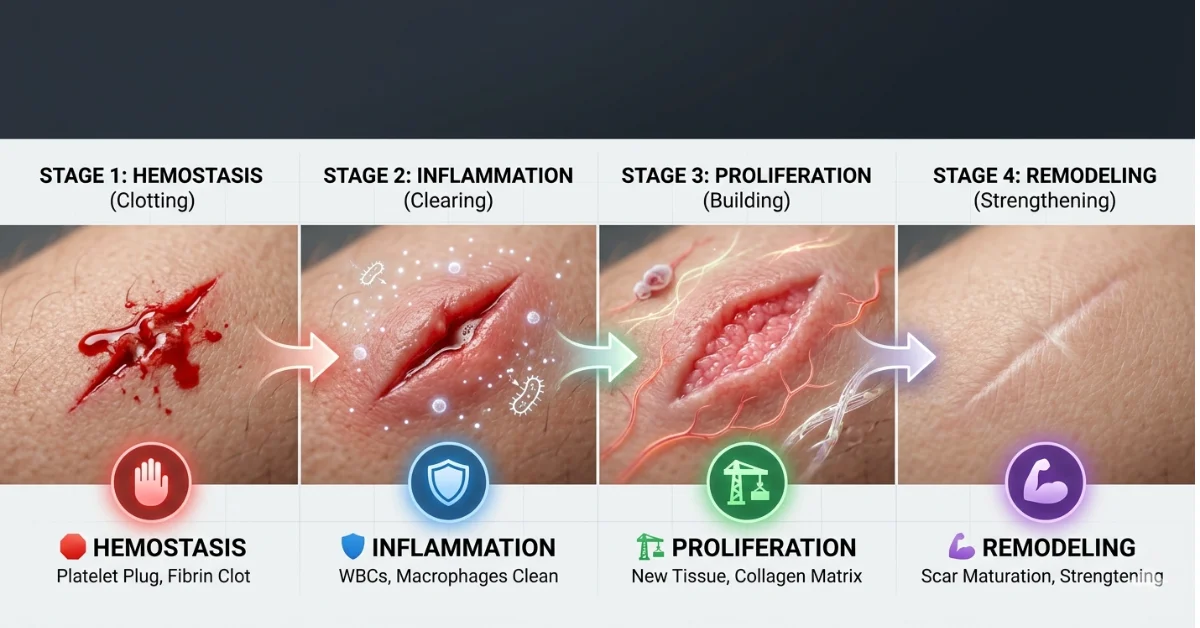
According to the National Institutes of Health, wound healing occurs in four overlapping stages, each with a specific job.
The 4 Stages of Wound Healing Explained Simply
| Stage 1 — Hemostasis (Seconds to Minutes) |
This is your body’s emergency stop. The moment a cut happens, your blood vessels constrict to reduce blood loss. Then platelets rush to the wound site and stick together, forming a blood clot. A protein called fibrin acts like a net, reinforcing that clot into a stable seal. You know hemostasis worked when the bleeding stops.
| Stage 2 — Inflammation (Hours to 4 Days) |
Once the clot is secure, your immune system kicks in. Neutrophils — a type of white blood cell — arrive first and destroy any bacteria or debris that enters the wound. After 24 to 48 hours, they are replaced by macrophages, specialized cells that clean up dead tissue and signal the body to start rebuilding. This is why a fresh cut looks red, feels warm, and may swell slightly. That’s not a bad sign. That’s healing in action.
| Stage 3 — Proliferation / Tissue Rebuilding (Day 4 to Day 21) |
This is where the real reconstruction happens. Your body grows granulation tissue — a soft, pink, bumpy layer of new cells that fills the wound bed. Fibroblasts produce collagen, the structural protein that gives skin its strength. New blood vessels form through a process called angiogenesis, bringing oxygen and nutrients to the repair site.
| Stage 4 — Maturation / Remodeling (Day 21 to 2 Years) |
Here’s what competitors rarely explain: the surface closing is NOT the end of healing. Under the skin, collagen fibers are still being reorganized, cross-linked, and strengthened for months — sometimes up to 2 years. Even after full closure, healed skin only reaches about 80% of its original tensile strength.
How Long Does a Cut Take to Heal? Day-by-Day Timeline
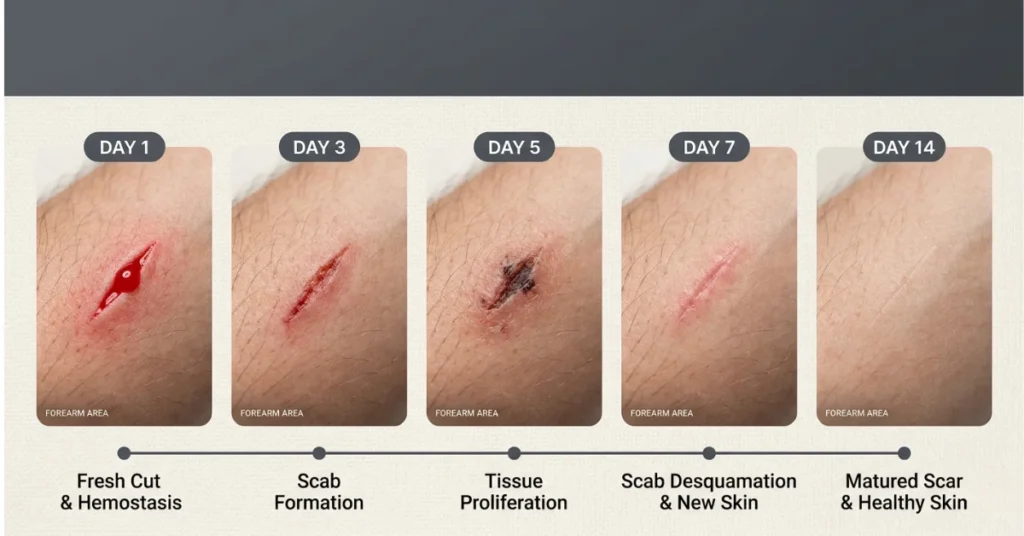
Here is what your body is actually doing — day by day.
Day 1 — Bleeding Stops, Clot Forms
Within seconds to minutes, hemostasis kicks in. By the end of day one, a clot has formed and dried into the beginning of a scab. The area may feel sore and tender.
- Do: Apply gentle pressure. Clean the wound with saline or cool running water. Cover it.
- Don’t: Pick at the clot. Use hydrogen peroxide — it damages new tissue.
Days 2 to 3 — Redness, Swelling & Warmth
The inflammatory phase is in full force. The area around the cut may look red, feel warm, and appear slightly swollen. You may notice some clear or light pink fluid — this is called wound exudate, and it is part of the body’s natural cleaning process.
| Mild redness and warmth in the first 48 to 72 hours is normal inflammation — not infection. Infection signs look different and come later. |
Days 4 to 7 — Scab Forms, New Skin Grows Underneath
A visible scab has now formed. Underneath it, your body is building granulation tissue and the first layer of new skin. The wound is actively shrinking from the edges inward. For minor cuts, surface closure can happen here.
Days 7 to 14 — Itching Begins (A Good Sign)
Why does a healing cut itch? Because new nerve fibers are growing back into the repaired tissue. Itching is a biological signal that your body is rebuilding. Resist the urge to scratch — it can tear fragile new tissue.
Days 14 to 21 — Surface Looks Closed, But Healing Continues
By this point, most minor-to-moderate cuts look healed from the outside. But the underlying collagen matrix is still weak and being reorganized. The wound can still reopen with trauma or excess stretching.
Week 3 to Month 3 — Deep Tissue Rebuilding
The proliferation phase transitions fully into remodeling. Collagen fibers are laid down in stronger patterns. The scar may appear raised, red, or pink. Sunscreen is critical — UV exposure can permanently darken scar tissue.
Month 3 to 2 Years — Scar Fading & Final Strengthening
Most people don’t know this phase exists — but it’s real. The body continues refining the wound site for up to 2 years. Scars gradually fade from red or pink to a softer, skin-tone color. Collagen cross-linking increases tissue strength over time.
Healing Timeline by Cut Type
Not all cuts heal the same way. Here is what to actually expect based on your wound type:
| Wound Type | Surface Closes | Full Healing |
| Deep cut/stitches required | 3–7 days | Several weeks |
| Moderate cut/laceration | 2–3 weeks | 1–3 months |
| Deep cut / stitches required | 6–8 weeks | Up to 1 year |
| Surgical incision | 2–3 weeks (sutures removed) | 6–12 months+ |
| Chronic wound (no progress >4 weeks) | Specialist care needed | Varies |
Cuts on Joints, Knuckles & High-Movement Areas
These take longer because constant movement stretches the healing tissue. A cut on your knuckle, knee, or elbow faces mechanical stress every time you bend that joint. Flexible bandages and reduced movement significantly improve healing speed in these areas.
Why Is My Cut Not Healing?
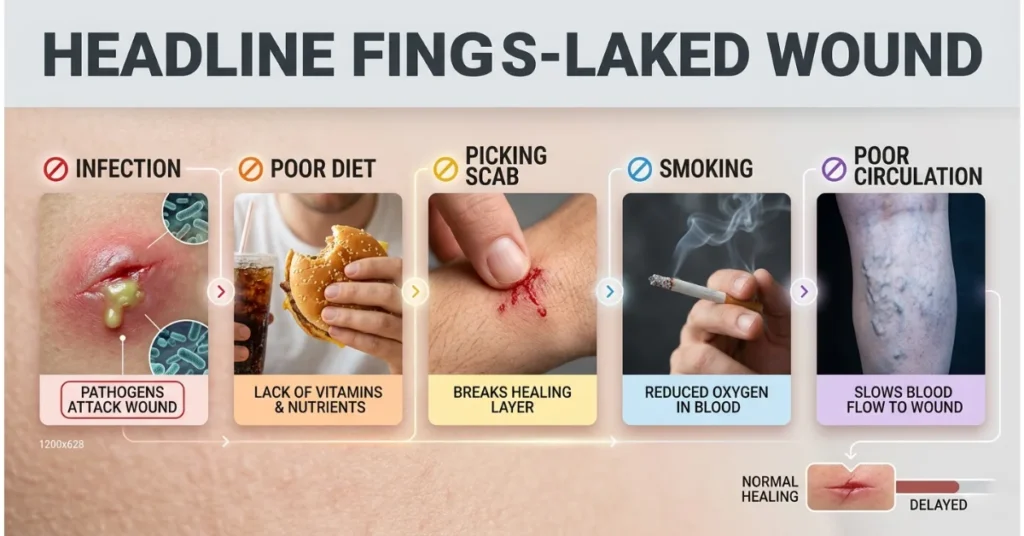
If your cut isn’t healing on schedule, something is getting in the way. Here are the real factors — many of which competitors overlook.
Diabetes & Poor Blood Circulation
This is the single biggest factor in slow wound healing in the US. People with diabetes have impaired blood flow, reduced immune response, and often peripheral neuropathy — meaning they may not feel a wound worsening. Wounds in people with diabetes often stall — they stop progressing and simply sit open. The tissue at the base looks gray, not pink. This is a chronic wound and requires specialist care.
Age & Nutrition Deficiencies
Older adults heal more slowly because skin cell turnover slows with age. Key nutrients for wound healing include:
- Vitamin C — essential for collagen synthesis
- Zinc — supports new tissue development and immune function
- Protein — the building block of every new cell
- Vitamin A — triggers early healing response
Smoking
Cigarette smoking constricts blood vessels, reducing oxygen delivery to healing tissue. Smokers have significantly longer wound healing times and higher complication rates. Even secondhand smoke during recovery can interfere with healing.
Infection — The Most Common Complication
A wound that becomes infected cannot heal properly. Your body diverts all resources to fighting bacteria instead of rebuilding tissue.
Signs your cut may be infected:
- Increasing pain after the first 48 hours (not decreasing)
- Green, yellow, brown, or foul-smelling discharge
- Expanding redness spreading away from the wound
- Red streaks on nearby skin (seek care immediately)
- Fever above 100°F (37.7°C)
- The wound is getting larger, not smaller
| When Does a Cut Become a Chronic Wound? If a wound shows no measurable improvement after 4 weeks, it is classified as a chronic wound. According to UCHealth, 6.5 million Americans currently live with chronic wounds — costing the US healthcare system over $28 billion annually. |
How to Make a Cut Heal Faster — Evidence-Based Tips
These are the steps with actual clinical backing.
Keep It Moist, Not Dry
Letting a cut “air out” is one of the biggest wound care myths. Clinical research shows that moist wounds heal up to 2 to 3 times faster than dry ones. Moist environments allow new skin cells to migrate and divide more rapidly. Scab formation — which happens when a wound dries out — actually slows healing and increases scarring risk.
Clean It Right
- ✅ Saline solution — closest to the body’s natural fluids. Best choice.
- ✅ Cool running water — effective for flushing debris.
- ✅ Mild soap around (not in) the wound — acceptable for surrounding skin.
- ❌ Hydrogen peroxide — damages new tissue and delays healing.
- ❌ Rubbing alcohol directly on a wound — kills bacteria but also kills healthy cells.
Cover It Properly
Keep the wound covered with a clean, appropriate dressing. Change it daily, or sooner if it becomes saturated. For small wounds, an adhesive bandage works. For larger or draining wounds, sterile gauze with a secondary covering is more appropriate. Never leave a dressing on too long — it creates a breeding ground for bacteria.
Feed Your Healing — The Right Nutrients
Your diet directly affects how fast you heal. During recovery, prioritize:
- Lean protein (chicken, fish, beans) — 2 to 3 servings daily
- Citrus fruits and leafy greens — high in Vitamin C
- Nuts and seeds — rich in zinc
- Orange and yellow vegetables — high in Vitamin A
- Hydration — water keeps tissues supple and supports cell transport
What to Avoid During Healing
- ❌ Picking at scabs — tears new tissue and invites infection
- ❌ Soaking in baths or pools — softens the wound and introduces bacteria
- ❌ Smoking — reduces blood oxygen to healing tissue
- ❌ Sun exposure on healing skin — causes permanent darkening of scar tissue
Frequently Asked Questions About Cut Healing
Will a Cut Heal in 2 Days?
Most cuts will not fully heal in 2 days, but significant progress will happen. By day 2, hemostasis is complete, a clot has formed, and inflammation is underway. A very shallow scratch or paper cut may close at the surface within 2 days, but the underlying tissue continues to repair for weeks.
Do Cuts Heal Faster, Covered or Open?
Covered, always. Research consistently shows that covered wounds heal faster than open ones. A bandage maintains the moist wound environment that cells need to grow, protects against bacterial contamination, and prevents the wound from drying into a hard scab. The old advice to ‘let it breathe’ is outdated and not supported by clinical evidence.
What Are the 4 Stages of Wound Healing?
The four stages are hemostasis (bleeding stops, clot forms), inflammation (immune cells clean the wound), proliferation (new tissue and collagen form), and maturation (collagen remodels, scar fades). Every cut — from a paper cut to a surgical incision — goes through all four stages in the same order.
What are the signs of a Cut Healing?
Positive signs include: reduced redness and swelling after the first few days, the wound getting physically smaller (edges contracting), new pink skin forming at the wound margins, mild itching, and a scab that is dry and intact. A wound that looks smaller today than it did last week is healing properly.
What Speeds Up Wound Healing?
The top evidence-backed ways to speed up wound healing are: keeping the wound moist and covered, cleaning with saline or clean water, eating adequate protein and Vitamin C, avoiding smoking, staying hydrated, and following up with a doctor if no improvement is seen within 2 to 4 weeks.
What Color Does a Cut Turn When It’s Healing?
A healing cut goes through several color changes. Bright red in the first 1 to 2 days signals active inflammation. Pink or light red by days 4 to 7 indicates new tissue forming. Pale pink skin at the edges signals epithelialization. Gray or black tissue at the wound base is not normal — it signals dead tissue and requires immediate medical evaluation.
Conclusion
| How long does a cut take to heal? Anywhere from a few days to a few years — depending on depth, location, health, and how well you care for it. |
Your body knows what to do. Your job is to support the process — keep it clean, keep it moist, keep it covered, and feed it well.
If a wound isn’t improving within 4 weeks, don’t wait. Chronic wounds don’t resolve on their own. Reach out to a wound care specialist. Banner Health, UCHealth, University of Utah Health, and HealthPartners all offer dedicated wound care programs for exactly this reason.
Healing is a process. Give your body what it needs, and it will get there.
⚕ This article is for general educational purposes only and does not substitute professional medical advice. Always consult a licensed healthcare provider for wounds that are deep, infected, or not healing as expected.