You open the fridge. You see that leftover pizza. You’re excited — until you remember what reheating usually does to it.

Soggy crust. Rubbery cheese. Dry toppings. Not exactly the experience you were hoping for.
Here’s the truth: reheating pizza in the oven is the single best way to bring a cold slice back to life. When done right, you get a crispy crust, gooey melted cheese, and toppings that taste just as good as night one.
This guide covers everything — the right temperature, the right technique, the mistakes to avoid, and the secrets professional chefs use that most blogs never mention.
Why the Oven Is the Best Way to Reheat Pizza
Most people grab the microwave because it’s fast. But speed comes at a cost.
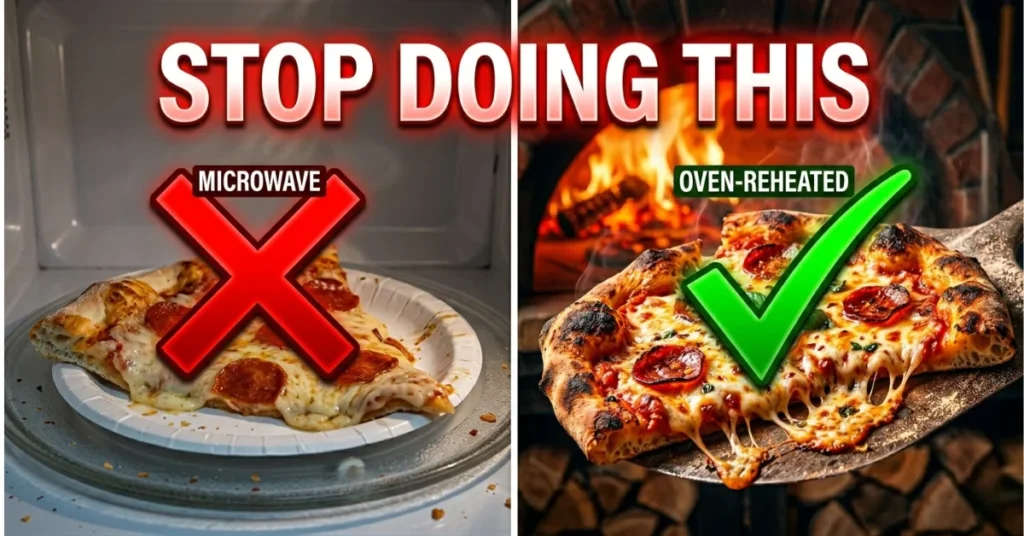
Microwaves heat food by agitating water molecules. That makes your pizza crust soft and chewy instead of crispy — the exact opposite of what you want. The cheese often turns rubbery or uneven.
The oven works differently. It surrounds the pizza with dry, even heat. The bottom of the crust re-crisps. The cheese melts slowly and evenly. The toppings warm through without sweating out moisture.
There’s also food science behind it. When pizza cools in the fridge, its starches go through a process called starch retrogradation — the crust hardens and stiffens as starch crystals form and release moisture. Heating the pizza above 140°F reverses this process. The starch crystals break down again, and the crust becomes pliable, crispy, and fresh-tasting.
The oven is the only home method that mimics the original baking environment closely enough to achieve this properly.
That said, if you’re only reheating one or two slices, a cast-iron skillet on the stovetop is actually faster and just as effective. The oven shines when you have multiple slices or a thicker-style pizza, like deep dish or pan pizza.
Reheating Method Comparison
| Method | Best For | Crust Result | Time |
| Oven | 3+ slices, deep dish | Crispy, even | 8–12 min |
| Skillet | 1–2 slices | Crispy bottom | 6–10 min |
| Air Fryer | 1–2 slices, quick | Crispy overall | 3–5 min |
| Microwave | Last resort only | Soft, soggy | 1–2 min |
Convection ovens reheat pizza noticeably better than conventional ovens. The fan circulates hot air, which speeds up crisping and reduces hot spots. If your oven has a convection setting, use it and drop the temperature by about 25°F.
For more info: How to Deodorize Shoes: The Complete Guide to Fresh-Smelling Footwear
How to Reheat Pizza in the Oven — The Right Way
This is where most guides go wrong. They give you a temperature and a time. That’s not enough.
The method matters just as much as the temperature.
What You’ll Need
- Baking sheet, pizza stone, or baking steel
- Aluminum foil or parchment paper
- Oven mitts
- Optional: food thermometer (target internal temp = 165°F)
The Right Oven Temperature to Reheat Pizza
375°F (190°C) is the sweet spot for most leftover pizza.
It’s hot enough to crisp the crust and melt the cheese without burning the toppings or drying everything out.
But not all pizza is the same. Here’s how to adjust:
- Thin crust pizza → 400°F. Thin slices heat fast. Higher heat crisps the base before the top dries out.
- Regular / New York-style → 375°F. The standard setting works perfectly.
- Deep dish / Chicago-style → 350°F. Lower heat gives the thick center time to warm through without burning the edges.
- Stuffed crust → 375°F, but cover with foil for the first half of reheating so the cheese inside the crust melts before the outer crust over-crisps.
What about reheating pizza at 180°C (356°F)? This is common in countries that use Celsius. It works, but runs slightly cooler than ideal. Expect to add 2–3 extra minutes. For most slices, you’re looking at 10–14 minutes at this temperature.
Step-by-Step Instructions
- Preheat the oven fully. This is non-negotiable. Give your oven 10–15 minutes to reach temperature before the pizza goes in. Placing pizza in a cold oven means it heats slowly and unevenly — the crust won’t crisp properly.
- Use the hot baking sheet trick. Place your baking sheet in the oven while it preheats. When the pizza hits a hot surface, the bottom starts crisping immediately — just like a pizza deck oven at a pizzeria. This is the single most effective tip for getting a crispy bottom crust. A pizza stone or baking steel works even better.
- Let the pizza come to room temperature first. Take the pizza out of the fridge 10–15 minutes before reheating. Cold pizza dropped onto a hot surface reheats unevenly.
- Place slices correctly. Lay slices in a single layer with space between them. Never stack or overlap. Overlapping slices trap steam and make both slices soggy.
- Decide: foil or no foil? No foil = crispier crust. Foil loosely over the top = cheese stays moist, better for deep dish. Foil only for the first half = best of both worlds.
- Reheat by crust type: Thin crust 6–8 min | Regular NY-style 8–10 min | Pan pizza 10–12 min | Deep dish 12–15 min at 350°F.
- Use the visual cue test. The pizza is ready when the cheese is bubbling, and the bottom crust is golden and firm. Gently lift a corner with a spatula — if it’s limp, give it 2 more minutes.
- Try the broiler finish. After the main reheat, switch your oven to broil for 60 seconds. This gives the cheese that slightly golden, blistered finish you see at real pizzerias. Watch it closely.
- Rest before eating. Let the slices sit for 1–2 minutes after pulling them from the oven. This lets the cheese set slightly and prevents burning the roof of your mouth.
Oven Reheating Mistakes That Ruin Your Pizza (And How to Fix Them)
Even with the right temperature, small errors wreck the result. Here’s what goes wrong and exactly how to fix it.
| Mistake | Why It Happens | The Fix |
| Soggy crust | Low temp or foil left on too long | Higher heat, remove foil last 3 mins |
| Dry toppings | Too high heat, left uncovered | Cover with foil, lower temp |
| Rubbery cheese | Oven not fully preheated; straight from the fridge | Pull at 165°F; use broiler finish instead |
| Cold center, hot edges | Thin crust on a very hot bare rack | Preheat 10–15 min; rest pizza at room temp first |
| Burnt bottom crust | Use parchment on baking sheet; raise the rack one level | Use parchment on a baking sheet; raise the rack one level |
| Uneven heating | Slices overlapping or stacked | Single layer only with space between slices |
How to Store Pizza Before Reheating (So the Oven Can Do Its Job)
How you store pizza directly affects how well it reheats. This is something most reheating guides completely skip over — and it matters a lot.
According to the USDA, pizza should not sit at room temperature for more than 2 hours. Between 40°F and 140°F is the “danger zone” where bacteria multiply rapidly.
In the fridge: Properly stored pizza lasts 3–4 days. The key is sealing it properly.
- Best option: an airtight container with a tight-fitting lid
- Good option: wrap each slice individually in aluminum foil or plastic wrap
- Worst option: leaving it in the open pizza box — cardboard lets air circulate and dries out the crust overnight
Pro tip: Place a paper towel at the bottom of the container to absorb excess moisture. This keeps the crust from getting soggy during storage, which means a much better result when you reheat.
In the freezer: Pizza keeps for 1–2 months. Wrap each slice individually in plastic wrap, then place in a freezer-safe zip bag to protect against freezer burn.
Before reheating frozen pizza: Let slices thaw in the fridge overnight, or on the counter for 15–20 minutes. This prevents the outside from overheating while the center is still frozen.
Note on toppings: Pizzas with vegetable toppings (mushrooms, peppers, onions) release more moisture as they cool. These slices are better reheated in the oven — uncovered — so excess moisture can evaporate.
How Professional Chefs Reheat Pizza (Secrets You Can Use at Home)

It’s where you find the biggest upgrades.
Professional chefs don’t use conventional ovens at 375°F. They use pizza deck ovens that run at 500°F and above. The intense, direct heat from the stone deck crisps the crust in under 2 minutes while the overhead heat melts the cheese perfectly.
The baking steel method is the closest home equivalent to a professional deck oven. A baking steel (brands like Baking Steel® are well-known for this) is denser than a pizza stone and conducts heat far more efficiently. Place it in your oven and preheat at the highest temperature your oven reaches — usually 500–550°F — for at least 45 minutes. Then slide your leftover slice directly onto the steel. It reheats in 2–4 minutes with a genuinely restaurant-quality crust.
The broiler trick is what chefs use for that golden, slightly blistered cheese finish. After reheating, switch to broil for 45–60 seconds. Stand at the oven. This step takes the result from “good reheat” to “looks freshly made.”
Chefs never use the microwave for pizza. Full stop. The microwave can’t crisp a crust — it can only steam food from the inside out.
The cold skillet technique: Place cold pizza in a cold, dry cast-iron or nonstick skillet. Set to medium-low. Cover with a lid. The bottom crisps slowly from direct contact with the pan. The steam trapped by the lid re-melts the cheese from above. According to King Arthur Baking, this process takes 6–10 minutes and works because heating to 140°F reverses the starch retrogradation that made the crust stiff.
One more pro move: before reheating, brush the exposed crust edge lightly with olive oil. This keeps the outer crust from drying out and gives it a slightly glossy, bakery-fresh appearance. Add any fresh toppings — fresh basil, arugula, or fresh mozzarella — after reheating, never before.
FAQ — Your Pizza Reheating Questions Answered
Q: What is the best way to reheat pizza in the oven?
Preheat your oven to 375°F. Place a baking sheet inside while it heats up. Once preheated, lay your pizza slices on the hot sheet in a single layer. Reheat for 8–10 minutes for a regular slice, until the cheese is bubbling and the crust bottom is firm and golden. Finish with 60 seconds under the broiler for a restaurant-style result.
Q: How long to reheat pizza in the oven at 180°C?
180°C equals about 356°F — slightly cooler than the ideal 375°F (190°C). At this temperature, thin crust takes around 8–10 minutes, and thicker slices take 12–14 minutes. For the best results, bump up to 190°C if your oven allows it.
Q: How do professional chefs reheat pizza?
Chefs use high-temperature deck ovens at 500°F or above. At home, the best equivalent is a baking steel preheated at maximum oven temperature for 45 minutes. They also use a broiler finish for 45–60 seconds to achieve golden, blistered cheese — and they never use a microwave.
Q: What’s the secret to great reheated pizza?
Three things: a preheated baking surface (not a cold pan), the right temperature for your crust type (375°F for most), and a broiler finish for the last 60 seconds. Letting the pizza come to room temperature before reheating is the bonus move most people skip.
Q: How to reheat pizza so it’s crispy?
Use the hot baking sheet method at 375–400°F. For maximum crispiness, skip the foil, place thin slices directly on the rack, and finish under the broiler for 60 seconds. A baking steel gives the crispiest possible result at home.
Q: What is the best way to eat leftover pizza?
Reheated in the oven at 375°F — it’s not even close. The oven restores the crispy crust, gooey cheese, and balanced toppings that made the original slice great. Cold pizza from the fridge is a legitimate second option. The microwave is a last resort.
Conclusion
Reheating pizza in the oven is simple when you know what you’re doing.
Preheat fully. Use a hot surface. Match the temperature to your crust type. Finish under the broiler. That’s the framework.
Everything else — the foil strategy, the room temperature tip, the baking steel upgrade — takes the result from acceptable to genuinely impressive.
No more soggy crusts. No more rubbery cheese. Just a crispy, melty, fresh-tasting slice — every time.