You want a perfect boiled egg. But every time, it comes out too runny or too rubbery.
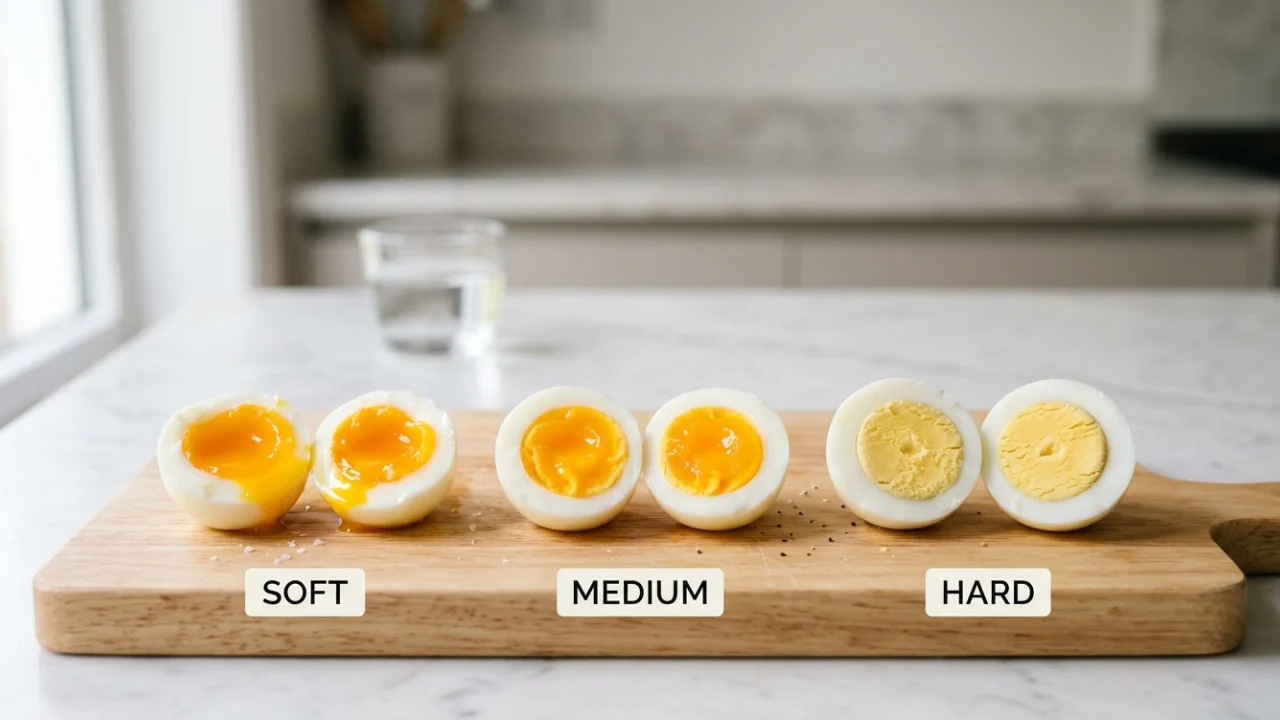
The fix is simple: exact timing. Once you know the right minutes for soft, medium, and hard-boiled eggs, you will never guess again. This guide gives you the precise times, tested methods, and pro tips that make every egg exactly right.
How Long to Boil an Egg — The Exact Times You Need
The difference between a runny yolk and a firm yolk is just a matter of minutes. Here is the complete boiled egg timing chart based on large, fridge-cold eggs lowered into already-boiling water:
| Doneness Level | Time (from boiling water) | Yolk Texture | Best For |
| Dippy / Soldiers | 3 minutes | Liquid, very runny | Toast dipping |
| Soft Boiled | 6 minutes | Runny, barely set | Ramen, avocado toast |
| Jammy / Medium | 8 minutes | Creamy, semi-firm | Salads, grain bowls |
| Classic Hard Boiled | 10 minutes | Fully set, light | Egg salad, snacking |
| Fully Hard Boiled | 12–14 minutes | Firm, pale yellow | Deviled eggs, meal prep |
Always use large eggs as your baseline. For extra-large eggs, add 30 seconds. For jumbo eggs, add 1 full minute.
Soft Boiled Egg Timing — Runny Yolk
At 6 minutes, you get a soft boiled egg with fully set whites and a warm, flowing yolk. This is the gold standard for ramen topping, avocado toast, and grain bowls. Handle gently — the white is set but still delicate.
At just 3 minutes, you get a dippy egg — ideal for toast soldiers, but too soft to peel.
Medium Boiled Egg Timing — Jammy Yolk
At 8 minutes, the yolk turns jammy — creamy, custard-like, and slightly soft in the center. This is the sweet spot for salads, noodle dishes, and grain bowls. According to food thermometer testing, the ideal jammy yolk reads 145–150°F (63–66°C) at its center.
Hard Boiled Egg Timing — Fully Set Yolk
At 10 minutes, you reach a classic hard boiled egg — yolk fully set, light yellow, creamy but not chalky. Perfect for egg salad, deviled eggs, and quick protein snacks. The USDA confirms hard boiled eggs are safe and can be stored in the refrigerator for up to 7 days.
Go beyond 12–14 minutes and you risk the dreaded grey-green ring around the yolk — a sign of overcooking that affects taste and texture.
For more info: How Long to Grow 1, 3, or 6 Inches of Hair? Full Breakdown
Cold Water Start vs Boiling Water Start — Which Is Better?
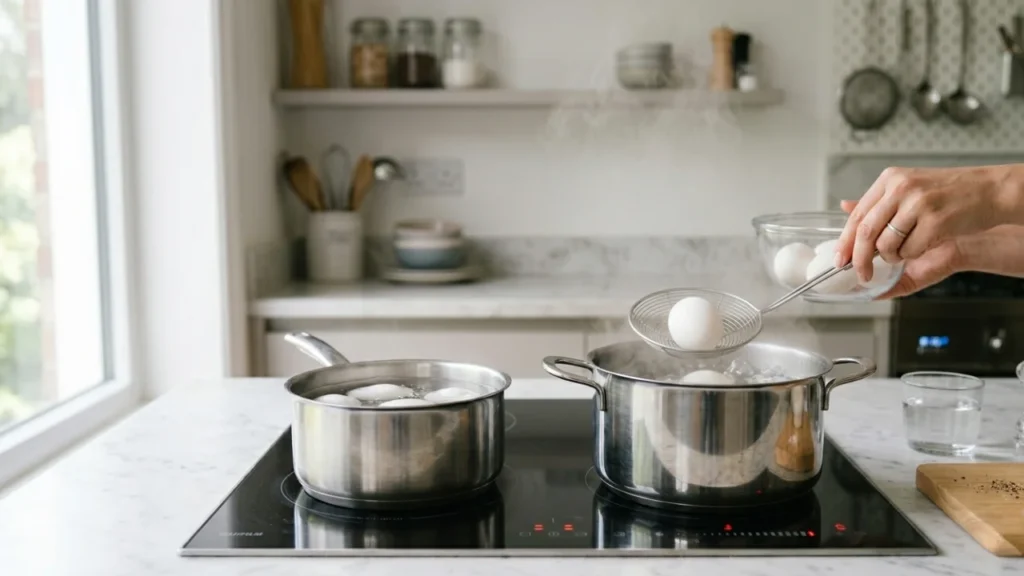
This is the most debated question in egg-boiling. Both methods work — but they are not interchangeable. Here is the honest breakdown:
The Cold Water Method
Place eggs in cold water, then bring to a boil. This is the classic American method used by The Kitchn and Food52. The problem? Timing becomes inconsistent because every stove heats at a different rate. A cast iron pot takes longer to boil than aluminum — meaning your egg cooks longer before the timer even starts.
The Boiling Water Method
Bring water to a full rolling boil first, then lower eggs in gently. Used by RecipeTin Eats, Downshiftology, and BBC Good Food. This method gives you a consistent, repeatable baseline. Your timer starts the moment the eggs hit 212°F (100°C) water — no variables, no guesswork.
Which Method Gives Better Results?
For soft and medium boiled eggs, the boiling water method wins every time. It gives precision you simply cannot get with cold water. For hard boiled eggs, both methods can work — but boiling water start still produces more consistent results and easier-to-peel eggs.
The Ice Bath — Why It Matters More Than You Think
That is exactly why their eggs overcook or refuse to peel.
What Is an Ice Bath and Why Use It?
An ice bath is a bowl filled with ice and cold water. The moment your timer goes off, the eggs go straight in. Why? Because carryover cooking is real. Residual heat inside the egg continues cooking the yolk even after you pull it from the pot. Without an ice bath, a 6-minute egg becomes an 8-minute egg.
The ice bath also prevents the grey-green sulfur ring that forms around overcooked yolks. That ring is caused by iron in the yolk reacting with hydrogen sulfide in the white — it is triggered by heat exposure, not flavor chemistry.
How to Ice Bath Eggs Correctly
- Fill a large bowl with ice and cold water — aim for a 50/50 ice-to-water ratio
- Transfer eggs immediately when the timer ends — use a slotted spoon
- Leave eggs in the ice bath for at least 5 minutes for soft boiled, 10 minutes for hard boiled
- No ice? Run under cold tap water for 60 seconds — it slows cooking but is less effective than ice
How to Peel Boiled Eggs Easily Every Time
Peeling is where most people struggle. Here are the chef-tested tricks that actually work:
- Peel under running water — water gets between the membrane and shell, reducing friction
- Start from the base — the wide end has an air pocket that gives you a natural entry point
- Use older eggs — as eggs age, the air pocket grows, making them dramatically easier to peel
- The shake method — crack the egg, put it in a glass with water, shake vigorously; the shell releases like a skin
Fresh eggs are the hardest to peel. If you are boiling eggs for a party or meal prep, buy them 5 to 7 days ahead for effortless peeling.
What Affects Your Boiling Time?
Most tutorials ignore these variables. But they change your results every single time.
Egg Size and Temperature Matter
All timing charts assume large eggs straight from the refrigerator. A room-temperature egg cooks 1 to 2 minutes faster than a fridge-cold egg. An extra-large egg needs 30 extra seconds. A jumbo egg needs a full extra minute. Always use cold eggs from the fridge for the most predictable results.
Altitude Effect on Boiling Eggs
This is the factor almost no competitor mentions — and it is critical if you live in Denver, Salt Lake City, or any high-elevation area. At altitude, water boils at a lower temperature than 212°F. At 5,000 feet, water boils at around 202°F. That means your eggs cook slower and need 1 to 2 extra minutes compared to sea-level timing.
Fresh Eggs vs Older Eggs — Which Boils Better?
Fresh eggs and older eggs boil at the same rate — timing does not change. But older eggs peel dramatically better because the air pocket inside grows as moisture evaporates over time. For eating immediately? Fresh eggs taste better. For meal prep and batch cooking? Use eggs that are 5 to 7 days old.
Why Does the Yolk Turn Grey-Green?
The grey-green ring around the yolk is caused by a chemical reaction: iron in the yolk meets hydrogen sulfide released by the white when overheated. It is harmless but affects taste and texture. The fix is simple — never cook beyond 12 minutes and always use an ice bath immediately after cooking.
Are Boiled Eggs Healthy? What Cardiologists Actually Say

Eggs have been debated for decades. Here is what current science and leading cardiologists actually say — not outdated myths.
Is Boiled Egg Good for Heart Patients?
Yes — in moderation. According to Dr. Pradeep Natarajan, cardiologist at Massachusetts General Hospital, eggs can be part of a heart-healthy diet when limited to about one per day on average. A 2020 meta-analysis confirmed that moderate egg consumption (up to one per day) was not associated with cardiovascular disease risk.
The American Heart Association (AHA) states that adults with normal cholesterol can safely consume up to seven eggs per week. For those with existing heart disease or high LDL cholesterol, limiting to no more than 7 eggs per week with medical guidance is advised.
Boiled eggs are the healthiest cooking method for heart patients — no added oils, butter, or saturated fats. Cleveland Clinic dietitian Julia Zumpano specifically recommends boiling or poaching over frying.
Is 2 Eggs a Day Too Much Cholesterol?
One large egg contains about 186 mg of dietary cholesterol — concentrated in the yolk. Two eggs brings that to roughly 372 mg per day. However, Harvard Medical School research confirms that dietary cholesterol has a minimal impact on blood cholesterol levels for most people. The liver — not diet — controls most circulating cholesterol.
What matters more is saturated fat intake, not dietary cholesterol. A hard boiled egg contains only about 1.6 grams of saturated fat — well within healthy daily limits. For most healthy Americans, 2 eggs per day is not harmful. Those with type 2 diabetes or pre-existing heart conditions should consult their doctor.
Three Foods Cardiologists Say to Avoid
While boiled eggs are generally safe, these are the three foods cardiologists consistently flag as genuinely harmful for heart health:
- Processed meats (bacon, sausage, deli meats) — high in sodium, saturated fat, and nitrates that directly raise cardiovascular risk
- Trans fat foods (fried fast food, partially hydrogenated oils) — shown to raise LDL and lower HDL, the worst combination for heart health
- Sugar-sweetened beverages (sodas, energy drinks) — strongly linked to obesity, diabetes, and elevated triglycerides, all major heart disease risk factors
Ironically, eggs are not on that list. The problem is what Americans eat alongside eggs — bacon, buttered toast, processed cheese — not the egg itself.
FAQ — Your Top Boiled Egg Questions Answered
Is 10 minutes long enough to hard boil an egg?
Yes — 10 minutes produces a classic hard boiled egg with a fully set yolk that is light yellow and creamy. It is not overcooked. If you want an even firmer yolk (useful for deviled eggs or egg salad), go to 12 minutes. Beyond 14 minutes, you risk the grey-green ring and a rubbery white.
What is the 5 5 5 rule for eggs?
The 5 5 5 rule is an Instant Pot egg method — not stovetop boiling. It means: 5 minutes on high pressure, 5 minutes natural release, 5 minutes in an ice bath. This produces consistently hard boiled eggs that peel easily every time in a pressure cooker. For stovetop boiling, use the timing chart in this guide instead.
Do you boil eggs for 30 minutes?
Absolutely not. 30 minutes of boiling destroys an egg. The whites become rubbery and dry, the yolk turns chalky grey-green, and the sulfur smell intensifies. Hard boiled eggs only need 10 to 14 minutes maximum from boiling water. Anything beyond that is overcooking — not safety.
Is boiled egg good for heart patients?
Yes — boiled eggs are the best preparation method for heart patients because no oil or butter is added. One egg per day in moderation is considered safe by most cardiologists, including those at Mass General Brigham and Cleveland Clinic. Those with high LDL or existing heart disease should consult their physician for personalized guidance.
What are three foods cardiologists say not to eat?
Cardiologists most consistently warn against: processed meats (bacon, sausage, hot dogs), trans fat foods (fried fast food, packaged snacks with partially hydrogenated oils), and sugar-sweetened drinks (soda, sports drinks, sweetened coffee). These have the strongest evidence for raising cardiovascular disease risk.
Is 2 eggs a day too much cholesterol?
For most healthy adults, 2 eggs per day is not too much. Harvard Medical School studies involving hundreds of thousands of participants found no increased cardiovascular disease risk from eating up to one egg daily. Two eggs bring your dietary cholesterol to about 372 mg — but remember, your liver produces far more cholesterol than food provides. For those with diabetes or elevated LDL, speak with a doctor about appropriate limits.
Conclusion
Boiling eggs perfectly is not complicated — it just takes the right timing and a few smart habits.
Use boiling water, a reliable timer, and an ice bath. Pick your time: 6 minutes for soft, 8 for jammy, 10 for hard. Adjust for egg size and your altitude. And do not fear eggs for your health — when boiled, they are one of the most nutrient-dense, heart-friendly protein sources you can put on your plate.
Start with one batch today. In 10 minutes, you will have perfect eggs — and you will never overcook them again.